
Views: 0 Author: Site Editor Publish Time: 2026-06-16 Origin: Site


Imagine discovering a shipping container full of unsellable garments only after they arrive at your destination warehouse. Retailer chargebacks begin piling up immediately. You scramble to arrange highly expensive return logistics. Worse, your brand reputation takes a massive hit from disappointed end consumers. You simply cannot afford to let defective inventory cross the ocean unnoticed. Pre-shipment inspection (PSI) serves as the critical final tollgate in the apparel production process. It definitively stops bad batches from ever leaving the factory floor. This guide provides a pragmatic, actionable framework for evaluating your current procedures. We will walk you through implementing robust checks before authorizing final shipment. You will learn how to balance statistical manufacturing realities against your exact brand standards. Protect your margins and customer trust by mastering these pre-shipment protocols today.
Effective apparel quality control before shipping relies on statistical sampling (AQL) rather than unrealistic expectations of 100% perfection.
Standardized garment quality inspection requires a documented, multi-point checklist covering measurements, workmanship, and packaging compliance.
Choosing between in-house factory QC and third-party inspectors depends on order volume, factory history, and risk tolerance.
A failed pre-shipment inspection is a feature of the system, not a flaw; the primary goal is preventing non-compliant inventory from entering the fulfillment chain.
Skipped pre-shipment checks hide massive supply chain costs. When defective units hit retail shelves, you face immediate financial drain. Unsalable inventory quickly creates expensive dead stock in your distribution centers. Expedited replacement shipping burns through your operational cash flow. Major retail partners will aggressively issue penalties or chargebacks for non-compliant deliveries. Effective bulk order quality control directly mitigates these severe hazards.
What does a successful pre-shipment process actually look like? First, you want highly predictable defect rates across all your suppliers. Second, you need transparent factory accountability backed by photographic evidence. Most importantly, zero critical defects should ever leave the origin port. Hitting these marks ensures smooth retail distribution.
We must acknowledge a hard truth about mass garment manufacturing. Absolute perfection is statistically impossible. Sewing remains a highly manual, human-driven process. Natural variations will inevitably occur across a production run. Your objective is not chasing zero defects across the board. Instead, focus strictly on margin protection and risk mitigation. You contain the manufacturing flaws within acceptable statistical limits. This mindset prevents endless production delays while safeguarding consumer safety.
To evaluate large batches objectively, the industry heavily relies on Acceptable Quality Limit (AQL). This methodology forms the undeniable backbone of any professional garment quality inspection. Recognized globally via standards like ANSI/ASQ Z1.4 or ISO 2859-1, AQL provides reliable statistical sampling plans. It tells inspectors exactly how many pieces to pull from a batch. It also dictates how many defects trigger a failed result.
Inspectors sort found defects into three distinct categories based on severity. The table below illustrates the standard industry tolerances for each category.
Defect Category | Definition & Examples | Standard Tolerance Limit |
|---|---|---|
Critical | Safety hazards or regulatory violations (e.g., broken needles, sharp edges, missing warning labels). | 0.0 (Zero tolerance) |
Major | Usability or cosmetic flaws causing returns (e.g., open seams, broken zippers, severe color shading). | Typically 2.5 |
Minor | Small flaws mostly unnoticeable to consumers (e.g., slightly uneven stitches, small uncut threads). | Typically 4.0 |
Brands must define their specific AQL thresholds based on market positioning. A luxury label charging premium prices requires much stricter AQLs. Fast fashion brands might tolerate higher minor defect rates to maintain volume output. You communicate these precise AQL expectations to your factory before signing the purchase order. Clear upfront communication prevents costly disputes during the final inspection phase.
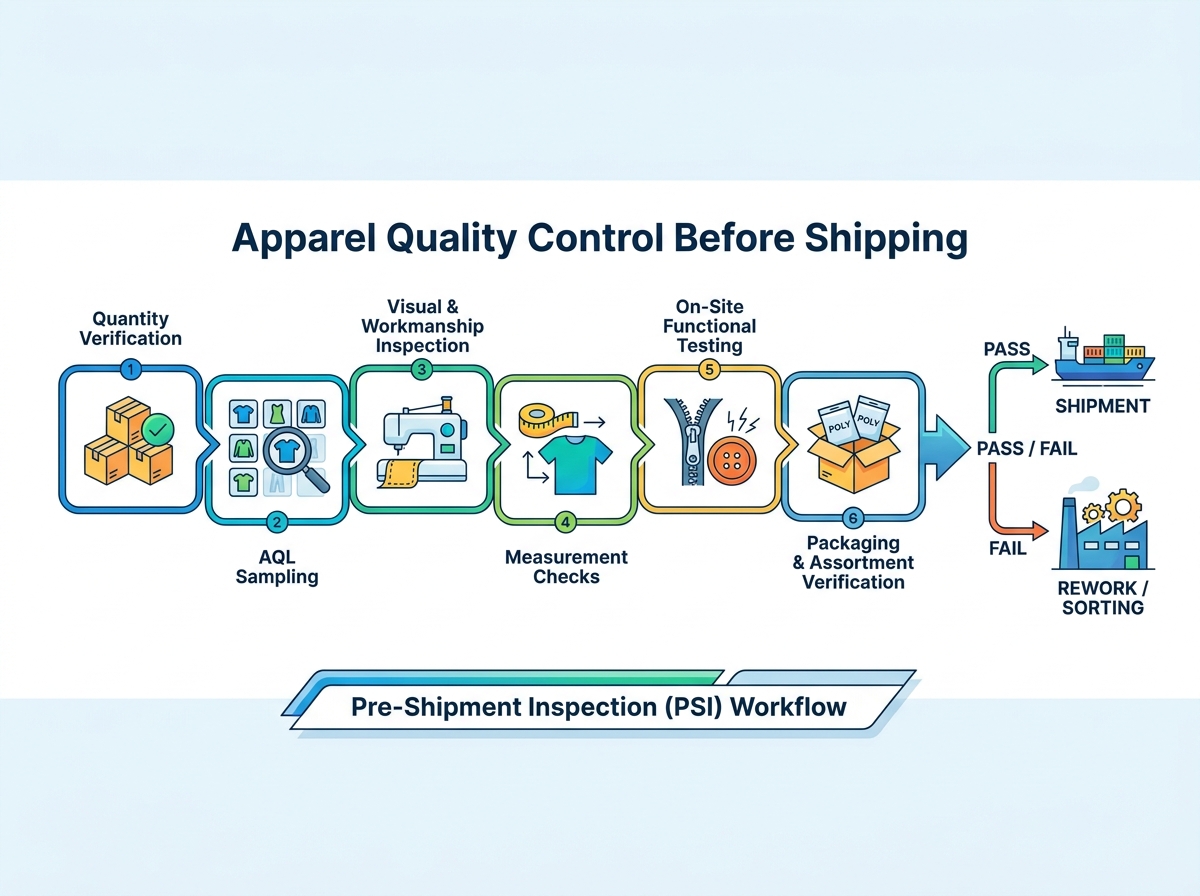
Executing professional apparel quality control before shipping requires a strict, unyielding sequence. You cannot skip steps without exposing your entire supply chain to risk. Here is the standard six-stage workflow used by industry professionals.
Inspectors start by counting the master cartons. They ensure the exact physical count matches the purchase order. They also cross-reference the factory packing list. They perform this check before the factory permanently seals the cartons for ocean transit. Short-shipping is a common tactic used to hide material shortages.
Inspectors must select cartons from various hidden locations across the factory warehouse. This prevents deceptive "cherry-picking" by factory staff. Sometimes, manufacturers place perfect garments at the very front of the pallet. True randomization ensures an accurate, unbiased representation of the entire batch.
Inspectors examine the pulled garments under bright, standardized lighting. They check diligently for crooked stitching errors. They look for obvious fabric weaving flaws and stubborn machine oil stains. They fold the garments to verify overall symmetry. This critical step catches the highest volume of major cosmetic defects.
Workers compare the physical garment dimensions against your approved tech pack. They use the defined sizing grades for every pulled SKU. Inspectors measure chest width, sleeve length, and inseams. Consistent sizing prevents massive e-commerce return waves driven by poor consumer fit.
Inspectors physically push the limits of the finished garment. They conduct repetitive zipper fatigue tests. They perform localized button pull tests using specialized force gauges. They scan barcode labels to ensure absolute retail readiness. Finally, they verify the fabric GSM weight and perform basic colorfastness rub tests.
The final stage focuses entirely on retail presentation. Inspectors confirm the use of correct polybags with required suffocation warnings. They check for adequate silica gel usage to prevent mold. They review master carton labeling for customs compliance. Finally, they ensure internal SKU ratios match the intended assortment plan.
Brands eventually face a crucial operational decision. Do you rely solely on the manufacturer’s internal QC team? Or do you hire an independent third-party inspection agency? Each distinct path offers different operational benefits and inherent risks.
Evaluation Dimension | In-House Factory QC | Third-Party Inspection Agency |
|---|---|---|
Objectivity | Low. Factories are incentivized to ship quickly to get paid. | High. Inspectors are incentivized only to report accurate data. |
Cost Profile | Included in the unit manufacturing cost. | Upfront cost of $300 to $500 per man-day. |
Scalability | Limited to the specific factory's internal capacity. | Highly scalable across multiple global manufacturing regions. |
Risk Level | High for new vendors; acceptable for trusted partners. | Low. Provides an external safety net against bad batches. |
Factories are heavily incentivized to ship goods rapidly. They desperately want to clear their pending invoice milestones. Conversely, independent third parties do not care about shipping speed. They exist solely to report facts accurately. They identify risks without internal production bias.
Hiring an agency does involve a direct upfront cost. You can expect to pay around $300 to $500 per man-day. Compare this fee against the backend cost of a completely ruined batch. A few hundred dollars serves as incredibly cheap insurance. It protects tens of thousands in retail value.
Third-party agencies also allow aggressive brands to scale efficiently. You can produce across multiple factories simultaneously. You never need to increase your internal headcount to manage the scattered oversight. Factory-led QC is often sufficient for long-term, highly trusted partners. However, independent inspections remain absolutely mandatory for new factories or high-value flagship orders.
Shifting to rigorous pre-shipment inspection protocols inevitably introduces friction. You must anticipate these operational realities to avoid supply chain shocks. Careful planning neutralizes most of these common implementation hurdles.
First, expect noticeable factory pushback. Manufacturers frequently resist external third-party inspectors. They view these auditors as a direct threat to their shipping timelines. You must manage this vendor relationship carefully. Frame the inspections as collaborative brand protection rather than a hostile audit.
Second, carefully plan for unexpected timeline delays. A failed pre-shipment inspection instantly halts the shipping process. You must build buffer time into your calendar. Garments might require tedious sorting or physical reworking on the sewing line. If you book shipping vessels too tightly, a single rework cycle will ruin your logistics plan.
Third, watch out for subjectivity in inspection reporting. Overzealous inspectors sometimes flag extremely minor variations. A tiny stitch inconsistency might not impact commercial viability whatsoever. Do not let minor visual flags derail your shipment unnecessarily. You must review reports with commercial pragmatism.
How do you mitigate these risks effectively? You need highly detailed, pre-approved QC Checklists. Furthermore, you must rely heavily on physical Golden Samples. The buyer signs off on these samples before bulk production begins. They serve as the ultimate, undeniable tiebreaker during any factory disputes.
Choosing the right third-party inspection service heavily dictates your success. You need a reliable partner aligned with your specific product complexity. Use strong decision logic when evaluating potential candidates. Assess their track record, geographic reach, and reporting transparency.
Ask these key questions during your vetting process:
Do they specialize strictly in softlines and apparel, or are they broad consumer goods generalists?
Are their inspectors full-time dedicated employees, or do they rely on outsourced local freelancers?
Do they provide comprehensive same-day digital reporting complete with clear photographic and video evidence?
Are they fully audited and compliant with rigorous anti-bribery standards, such as ISO 37001?
Take proactive action before you request external quotes. Finalize your internal tech packs completely. Draft a clear AQL tolerance document for your specific brand. Clear guidelines ensure the agency gives you a highly accurate inspection plan. Precision upfront prevents costly misunderstandings on the factory floor.
Standardized pre-shipment checks represent a mandatory operational investment. They aggressively protect your brand equity and preserve your hard-earned profit margins. We must remember that true quality is built during the actual manufacturing steps. However, the final inspection serves as your ultimate, unyielding enforcement mechanism. It acts as the final safety net you fully control.
You cannot leave your final product quality to mere chance. Document your expectations clearly. Define your acceptable statistical limits. Enforce your standards relentlessly before any carton gets sealed. Take concrete action today to secure your supply chain. Download a sample inspection checklist. Consult an online AQL calculator to understand your specific sampling needs. Request an inspection quote right now to secure your next major shipment.
A: DUPRO (During Production) happens when 20-80% of goods are finished. It helps catch early sewing errors before they multiply across the batch. PSI happens when 100% of garments are produced and at least 80% are packed in cartons. PSI serves as the final clearance before shipping.
A: Typically, the manufacturer covers all rework costs. However, you must establish a clear contract and an approved Golden Sample prior to production. If the factory deviated from the approved sample, they bear the full financial responsibility for fixing the batch.
A: Inspectors do not check a flat percentage. Instead, the exact quantity is determined by the AQL statistical sampling table. This calculation relies strictly on your total order quantity and your chosen inspection level (usually Level II).
A: Yes. Buyers hold the final authority to "Accept" or "Reject" any batch based on the inspection report. You can choose to waive minor defects by carefully weighing the flaw's severity against urgent shipping deadlines.


