
Views: 0 Author: Site Editor Publish Time: 2026-06-03 Origin: Site


Bringing a garment from a flat sketch to a physical product is thrilling. Yet, this transition represents the highest-risk phase for any emerging apparel business. Partnering with the wrong production facility often leads to delayed seasonal launches. It also severely compromises product quality. You risk sinking critical capital into unsellable inventory if communication breaks down. This operational bottleneck can easily derail your market entry.
Our comprehensive guide delivers a systematic, evidence-based framework. It helps you evaluate and shortlist reliable manufacturing partners. You will discover actionable strategies. These strategies align factory capabilities with your specific scaling goals. They also respect strict budget limits and baseline quality standards. We will walk you through the essential prerequisites. You will understand production models and learn to spot critical red flags. Read on to master your sourcing strategy.
Never approach a factory without a finalized Tech Pack and Bill of Materials (BOM); lack of preparation signals inexperience and inflates initial quotes.
The choice between an OEM and ODM production model dictates your level of creative control, upfront investment, and intellectual property ownership.
Evaluating a factory requires verifying third-party compliance audits, understanding their AQL (Acceptable Quality Limit) standards, and testing communication during the sampling phase.
Always negotiate the ownership of patterns and samples before paying tooling or sampling fees.
Founders often rush into contacting manufacturers before defining their product details. You must prepare technical documentation first. Factory managers judge your professionalism based on your initial outreach. Unprepared brands receive inflated price quotes. Some facilities simply ignore vague requests.
Comprehensive technical documents are mandatory for accurate quoting. Your Tech Pack serves as the architectural blueprint for your garment. It eliminates guesswork. Without it, factories estimate costs poorly.
Technical Sketches: Provide flat vector illustrations showing front, back, and side views. Highlight construction details clearly.
Measurement Specs: Include precise measurements for your base size. Add specific grading rules for your full size run.
Stitch and Seam Details: Specify stitch types. Activewear requires flatlock stitching for durability. Outerwear demands taped seams for waterproofing.
Bill of Materials (BOM): List every physical component. Detail the main fabric, lining, buttons, zippers, and thread. Include exact fabric yields per garment.
Common Mistake: Sending a mood board instead of a Tech Pack. Inspiration photos do not contain usable manufacturing data.
You must establish a Target Cost Price (TCP) immediately. This ensures financial viability before you evaluate proposals. Calculate your ideal retail price based on market research. Then, work backward to find your maximum allowable manufacturing cost. Knowing your margins keeps your business profitable. If a facility quotes far above your TCP, you can move on quickly. Do not waste time negotiating impossible margins.
Align your launch volume with standard Minimum Order Quantities (MOQ). MOQs protect factories from losing money on machine setup times. Specialized local facilities might accept orders of 50 units. Standard overseas facilities typically demand 300 to 500 units per colorway. Understand your inventory capacity. Do not commit to high MOQs just to secure a lower unit price. Unsold inventory drains your cash flow faster than premium small-batch surcharges.
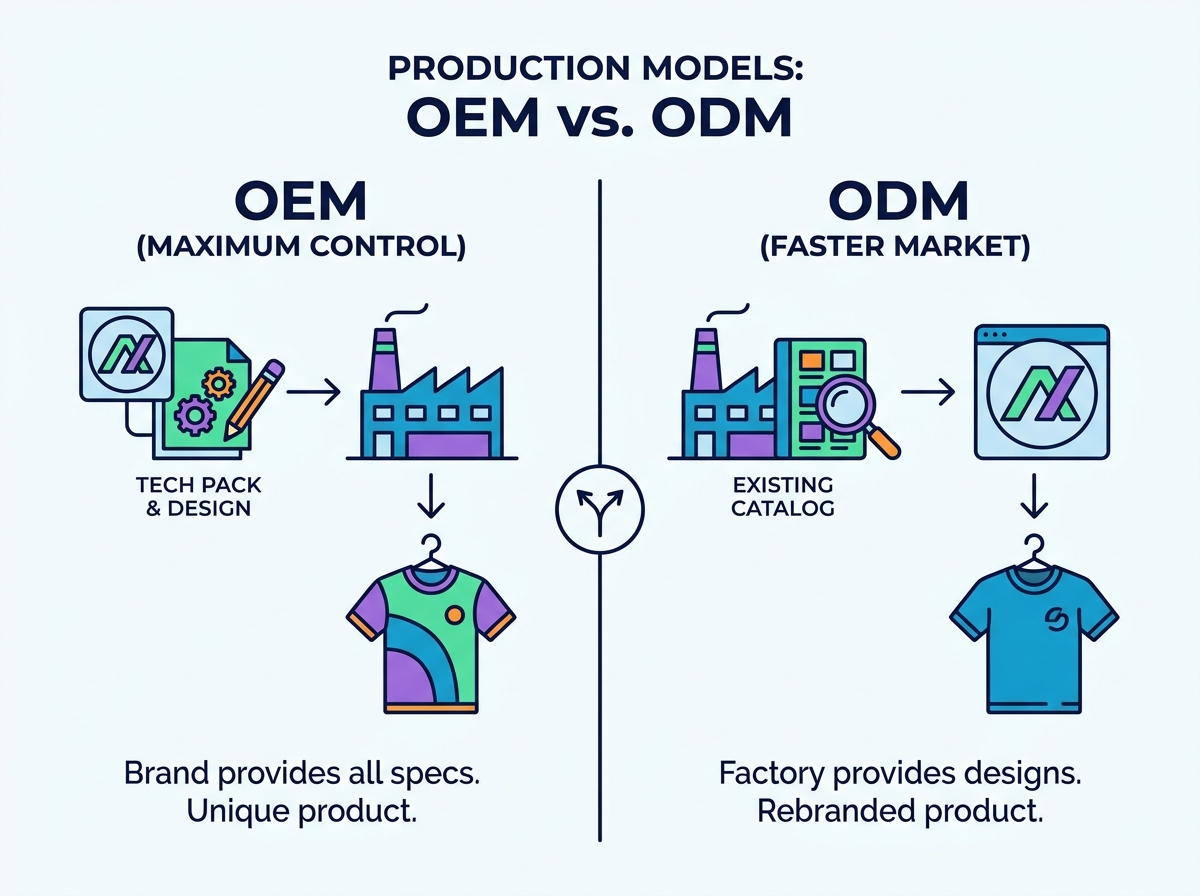
Selecting the right production model dictates your operational workflow. It determines your upfront investment. It also defines your intellectual property ownership. You must decide how much control you need over the design process.
Securing a reliable OEM ODM clothing service gives you strategic flexibility. These two models serve entirely different business objectives.
OEM (Original Equipment Manufacturer): This model offers maximum creative control. You provide the original designs, Tech Packs, and fabric specifications. The factory simply executes your vision. This approach is best for unique, high-end, or highly customized brands. You own the intellectual property. However, OEM requires significant upfront time for research and development.
ODM (Original Design Manufacturer): This approach guarantees a faster time-to-market. The factory provides a catalog of existing designs. You select styles and modify them slightly. You might change colors, fabrics, or simply add your brand labels. This lowers your R&D costs significantly. The trade-off is limited product differentiation. Other brands might sell nearly identical garments.
Beyond design ownership, you must choose how materials are sourced. This decision impacts your supply chain complexity.
FPP (Full-Package Production): The facility handles everything. They source the fabric, buy the trims, construct the garment, and package it. FPP saves you immense administrative time. It is ideal for newer brands lacking supplier networks.
CMT (Cut-Make-Trim): You source and purchase all raw materials yourself. You ship the fabric and trims to the factory. The facility only cuts the fabric and sews the garments. CMT offers total control over fabric quality. However, it requires intense logistical management on your part.
Factor | Full-Package (FPP) | Cut-Make-Trim (CMT) |
|---|---|---|
Sourcing Responsibility | Factory sources all materials | Brand sources all materials |
Time Investment | Low (Turnkey solution) | High (Heavy logistics) |
Material Control | Moderate (Depends on factory network) | Maximum (Brand chooses everything) |
Unit Cost | Higher (Includes sourcing markup) | Lower (Only paying for labor) |
Ideal For | Startups, brands scaling quickly | Established brands, niche fabrics |
You need a strict framework to evaluate potential partners. Do not rely on slick marketing websites. Ask probing questions. Finding a dependable custom clothing manufacturer requires thorough vetting across four key dimensions.
Match the factory's technical setup to your specific product category. Generalist factories often struggle with specialized garments. If you design activewear, verify they own flatlock stitching machines. If you produce technical outerwear, ask about their seam taping equipment. Request photos of their production floor. Ask what brands they currently produce. This reveals their true capabilities.
Never accept vague claims about "high quality." Professional facilities use standardized quality control metrics. Inquire about their internal QA processes. Industry leaders typically follow AQL (Acceptable Quality Limit) standards.
AQL 2.5: A strict standard often used for premium or luxury apparel. It allows very few defects per batch.
AQL 4.0: A standard metric for mass-market apparel. It tolerates a slightly higher percentage of minor defects.
Ask when inspections occur. Do they only check finished goods? Or do they perform inline inspections during sewing? Inline inspections catch errors before they compound.
Consumers demand transparency. Relying on self-reported ethical standards is dangerous. You must verify independent third-party certifications. Look for globally recognized frameworks.
WRAP (Worldwide Responsible Accredited Production): Ensures lawful, humane, and ethical manufacturing.
BSCI (Business Social Compliance Initiative): Focuses on improving working conditions.
OEKO-TEX Standard 100: Certifies garments are free from harmful chemicals.
Best Practice: Always ask for the certification number. Verify it directly on the issuing organization's official website. Certifications frequently expire.
Your factory's location impacts your entire business model. Weigh the trade-offs carefully.
Domestic production offers faster shipping lead times. Communication barriers are minimal. You can visit the facility easily. However, domestic labor rates drive unit costs much higher. Overseas production offers highly competitive pricing. These facilities often have massive material sourcing networks. The downsides include expensive import tariffs, long ocean freight delays, and potential language barriers. Calculate the final landed cost. The landed cost includes the unit price, shipping, insurance, and customs duties.
Experience teaches healthy skepticism. The manufacturing industry has hidden pitfalls. You must identify warning signs early. Protecting your brand requires vigilance.
Ghost factories are a massive industry problem. You might audit a beautiful, compliant facility. You sign the contract. Then, they secretly farm your order out to an unregulated, uncertified workshop. This practice destroys quality control. It also introduces severe ethical liabilities. Demand a contractual clause forbidding unauthorized subcontracting. Insist on knowing the exact physical address where your garments are sewn.
Protecting your designs is paramount. A standard Non-Disclosure Agreement (NDA) often fails overseas. Fast-fashion brands routinely steal unprotected designs. If producing in Asia, insist on an NNN agreement. NNN stands for Non-Disclosure, Non-Use, and Non-Circumvention. It prevents the facility from showing your designs to others. It stops them from using your patterns for their own brands. Most importantly, it forbids them from circumventing you to sell directly to your distributors.
Watch out for hidden fees. Disreputable facilities lure you in with low unit prices. Then, they hit you with unexpected surcharges. Always clarify the following costs upfront:
Pattern Making Fees: Who pays to draft the initial paper patterns?
Digitizing and Grading: Is grading the sizes included in the bulk price?
Tooling Costs: Are there setup fees for custom metal hardware or specialized dyes?
Sampling Costs: Are sampling fees credited toward the final bulk invoice?
Test their responsiveness during the quoting phase. Do they take five days to answer a simple email? Do they ignore specific technical questions? Slow response times now guarantee catastrophic delays during bulk production. A reliable partner communicates proactively. They flag errors in your Tech Pack. They suggest construction improvements. Poor communication is the leading cause of supply chain failure.
The sampling phase is your ultimate testing ground. It is an audition. Evaluating an apparel factory for brands requires patience. Do not rush straight to bulk orders.
Sampling follows a strict chronological order. Each stage serves a distinct purpose.
First Prototype (Proto Sample): The initial interpretation of your Tech Pack. It focuses on general design and proportions. The fabric might not be final.
Fit Sample: Created in the exact base size. You test this on a live fit model. You assess drape, movement, and sizing accuracy.
Size Run Sample: Tests the accuracy of your grading rules across multiple sizes.
Pre-Production (PP) Sample: The most critical stage. This garment uses the final bulk fabric, correct trims, and final stitching. Bulk production cannot begin until you approve the PP sample.
Top of Production (TOP) Sample: Pulled randomly from the first batch of the bulk assembly line. It confirms bulk quality matches the PP sample.
Use the sampling process to evaluate their problem-solving ability. Do they follow timelines? Do they correct fit issues accurately on the second iteration? Pay attention to detail. If the prototype features messy stitching, the bulk order will be worse. Good factories maintain consistency. If they struggle with samples, cut ties immediately. Sunk sampling costs are cheaper than ruined bulk inventory.
Once you approve the PP sample, finalize payment structures. Never pay 100% upfront for a bulk order. Standard industry practice dictates a split payment. A 30% upfront deposit covers raw materials and secures your spot on the production line. You pay the remaining 70% upon completion. Crucially, release the final payment only after the batch passes an independent third-party quality inspection. This structure aligns incentives. It ensures the factory maintains quality standards through the very last stitch.
Selecting the right production partner is not a simple one-off transaction. It demands the cultivation of a long-term strategic partnership. Your manufacturer acts as an extension of your own operations team. Rigorous vetting is your best defense against supply chain failures. You must provide clear technical documentation. You need protective contracts and an uncompromising approach to quality control. Finding the ideal clothing factory for fashion brand success takes time and diligence. Do not cut corners during the evaluation phase.
Take action today. Finalize your Tech Packs. Establish your Target Cost Price. Begin reaching out to a vetted shortlist of facilities using the criteria outlined above. A robust manufacturing partnership will ultimately scale your brand, protect your margins, and delight your customers.
A: Always require manufacturers to sign an NNN (Non-Disclosure, Non-Use, Non-Circumvention) agreement before sharing Tech Packs. This is far more enforceable internationally than a standard NDA. Ensure your brand name and logo are legally trademarked. Register your copyrights for unique textile prints. Never hand over full design files without a signed contract.
A: Standard Minimum Order Quantities (MOQ) vary wildly by location and specialization. Local or specialized boutique factories often accept MOQs of 50 to 100 units per style. Large-scale overseas manufacturers typically require 300 to 500 units per colorway. Negotiate MOQs based on your fabric commitments rather than just garment numbers.
A: Yes, paying for samples is standard industry practice. Factories invest significant labor and machine setup time into single garments. Expect to pay two to three times the estimated bulk unit price for a prototype. However, always negotiate to have these sampling costs credited toward your final bulk invoice if the full order proceeds.


