
Views: 0 Author: Site Editor Publish Time: 2026-06-12 Origin: Site


Transitioning from design validation to actual manufacturing is where emerging fashion brands face their highest financial risk. You often commit to massive inventory before establishing market fit. You tie up critical cash flow. You risk holding boxes of dead stock. Small batch production solves this immediate problem. However, it introduces entirely new variables. You must navigate complex per-unit economics and vet supplier reliability rigorously. This guide provides a critical evaluation framework for sourcing and partnering. You will learn to vet manufacturers properly. We ensure you protect your margins. You will maintain strict quality control throughout the process. Ultimately, you will build a solid foundation for scalable growth.
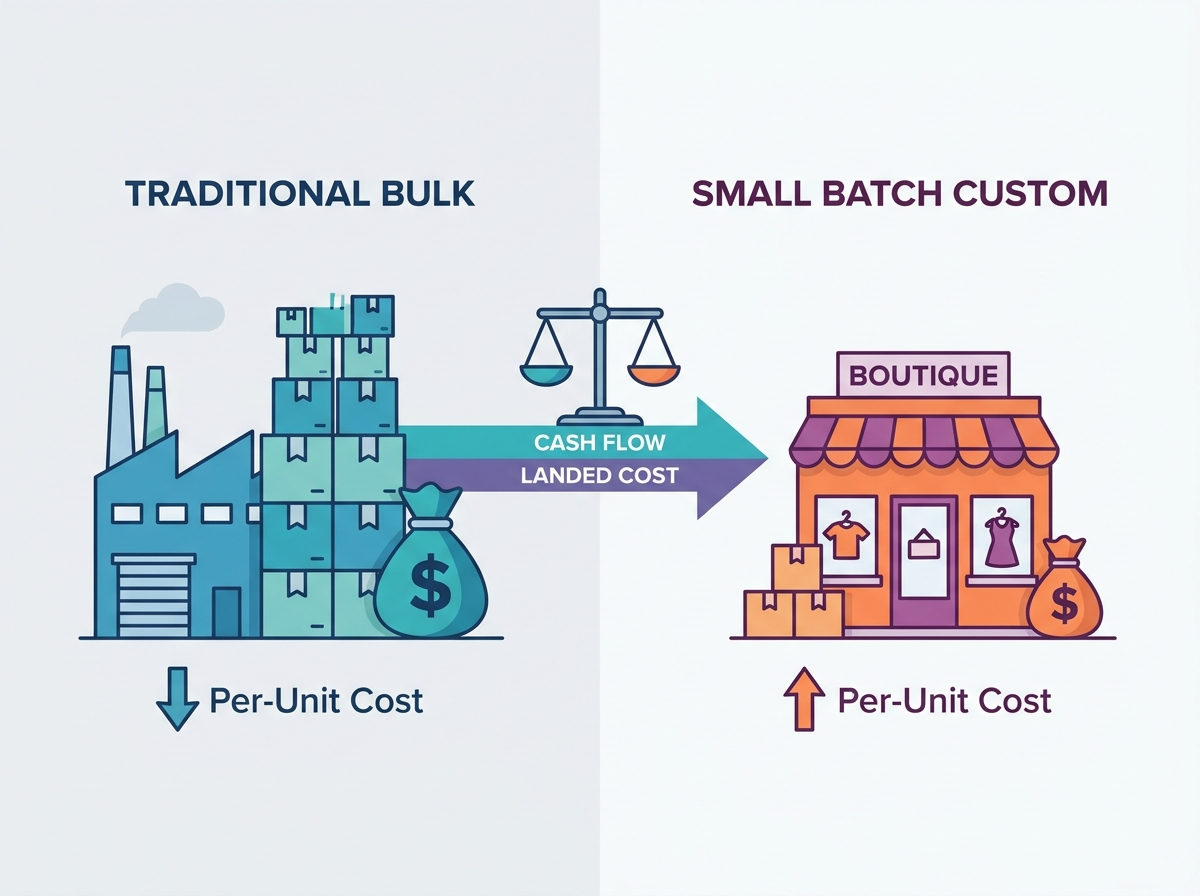
Unit Cost vs. Cash Flow: Small batch production incurs higher per-unit costs, but drastically reduces upfront capital risk and warehousing overhead.
Supplier Vetting is Critical: Not all manufacturers are structured for small runs; vetting requires assessing their communication, sampling process, and compliance standards.
The Sampling Mandate: Never move to production without a signed-off pre-production (PP) sample and an airtight tech pack.
Scalability Matters: A viable small batch partner must have a clear pathway to handle your future volume as demand grows.
What exactly defines a small batch? We must standardize minimum order quantities in today's manufacturing landscape. A typical low volume run involves 50 to 300 units per style and color. This specific range offers enough scale for factory efficiency. It also keeps your initial financial exposure exceptionally low.
Let us break down the total landed cost equation. You will inevitably see higher per-unit manufacturing costs. Factories must recoup their intensive setup time over fewer garments. However, total landed costs often favor smaller runs for entirely new product lines. Landed costs include storage fees, unsold inventory, and heavy retail markdowns. You avoid extensive warehousing fees. You sidestep the massive burden of unsold merchandise. Markdowns severely hurt luxury or boutique brand equity. Running smaller quantities inherently prevents excessive discounting.
View low MOQ clothing production as a strategic inventory management tool. It is not merely a frustrating sourcing limitation. You preserve essential cash flow for marketing campaigns. You fund customer acquisition instead of warehouse shelves. You test real market demand without overcommitting your limited budget.
Beware of hidden setup fees during small runs. Pattern making, grading, and tooling require significant upfront investment. These specific elements cost the same regardless of your run size. A factory charges flat fees for digitizing patterns. Spreading a $300 pattern fee across 50 units adds $6 per garment. Spreading it across 1000 units adds only $0.30. Transparency regarding these setup fees remains vital.
Economic Factor | Small Batch Strategy | Traditional Bulk Strategy |
|---|---|---|
Initial Capital Required | Very low; protects early cash flow | High; ties up significant funds |
Per-Unit Production Cost | Premium pricing due to scale limitations | Lowest possible pricing per garment |
Setup Fee Impact | Disproportionately high per unit | Easily absorbed into total volume |
Dead Stock Risk | Minimal; closely matches actual demand | High; often requires steep markdowns |
Selecting the right factory requires strict operational alignment. You must rigorously assess their specific product category expertise. A factory excelling in heavy denim might ruin delicate silk wovens. Activewear requires specialized flatlock stitching machinery. Ask for previous work samples in your exact category. Partnering with a specialized private label clothing supplier ensures they understand your distinct fabric behaviors.
Effective communication prevents disastrous manufacturing mistakes. A shared language reduces costly misinterpretations. Ensure you establish clear communication channels very early. Time-zone overlaps facilitate real-time problem-solving. If a factory takes three days to answer a simple question, walk away immediately.
Evaluate their ability to interpret complex tech packs. Ask them to point out potential construction flaws in your initial design. Experienced manufacturing partners will offer proactive suggestions. They spot technical errors before ever cutting your fabric.
Ethical manufacturing is no longer just optional. Modern consumers demand absolute transparency. You must verify their specific labor practices. Ask about recognized environmental certifications. Examples include WRAP or OEKO-TEX. These frameworks ensure safe working conditions. They guarantee chemical-free materials.
Compliance matters deeply for your brand reputation. Even at very low volumes, a supply chain scandal can destroy an emerging business. Protect your brand identity from day one. You should request recent audit reports from prospective factories.
Watch out for the "zero MOQ" red flag. Extreme low minimums often signal a hidden middleman or broker. Brokers inflate prices and delay critical timelines. True custom cut-and-sew operations require intensive manual labor. If someone promises zero minimums, they likely use off-the-shelf blanks. They just print your logo on pre-existing garments. This is not true custom manufacturing. Demand live video tours of their active cutting room floor.
A comprehensive tech pack acts as your ultimate blueprint. It serves as your primary defense against costly production errors. You must include a detailed Bill of Materials (BOM). Specify precise grading rules and exact construction details. Do not leave stitch density or thread color to chance. A factory will guess if you omit details. Their guess will rarely match your intended vision.
The sampling process involves multiple critical phases. You must follow them sequentially.
Fit Sample: You test the initial garment on a live model. You check drape, ease, and basic proportions.
Pre-Production (PP) Sample: This version uses the actual bulk fabric and all final trims. You must sign off on this sample before bulk cutting begins.
Top of Production (TOP) Sample: The factory pulls this directly from the very first bulk run. It verifies the final assembly line quality.
Establish strict measurement tolerances for every size. Create clear approval protocols for each distinct stage. Document every requested change in writing.
Quality control (QC) realities differ in small batch custom clothing production. Hiring expensive third-party inspection agencies can destroy your tight profit margins. Instead, implement a streamlined internal QC process. Ask the factory for daily inline inspection photos. Require detailed video evidence of measurements before final shipment.
Set realistic expectations for your lead times. Sourcing specialized raw materials often takes extra time. Initial sampling usually requires two to four weeks. Final assembly typically takes four to eight weeks. Build several buffer weeks into your official launch schedule. Delays happen frequently during custom runs.
Transitioning smoothly requires significant foresight. You must assess a supplier's maximum capacity early. Do this before ever signing your initial contract. A boutique factory might struggle when your sales suddenly spike. Ask about their maximum monthly output limits. Ensure they can scale alongside your brand smoothly.
Understand volume discount thresholds clearly. Economies of scale kick in at specific production milestones. Factories typically offer price breaks at 500, 1,000, and 2,500 units. Ask for a comprehensive tiered pricing matrix upfront. This document helps you project future profit margins accurately. Moving into bulk custom apparel orders changes your entire financial modeling strategy.
Material sourcing also evolves at scale. Beginners often rely on available-market fabrics. These include deadstock or retail roll ends. However, market fabrics lack long-term consistency. As order volumes increase, you transition to custom-milled fabrics. Custom milling guarantees exact color matching. It ensures consistent weight and drape across multiple production seasons.
Recognize exactly when to change factories. You will eventually reach a crucial inflection point. Your original boutique manufacturer can no longer support your margin requirements. They might lack the heavy machinery for massive automated runs. When migrating, protect your intellectual assets. Ensure you own your digital patterns entirely. Transfer your tech packs safely to the new partner. Conduct parallel sampling. This verifies the new factory can match your established quality.
Intellectual property protection remains a common blind spot. Navigate Non-Disclosure Agreements (NDAs) carefully. Always secure exclusive legal ownership of your patterns. Keep original source files for all digital assets. Unscrupulous factories might reuse your custom fits for other clients. Written contracts prevent unauthorized reproduction of your proprietary designs.
Fabric inconsistencies plague small runs frequently. Using available market fabrics introduces significant ongoing risks. You might face severe color matching issues on reorders. Mitigate this by buying extra raw fabric upfront. Reserve specific rolls at the factory for future batches. If you cannot reserve fabric, prepare your customers for slight seasonal variations.
Standardize your factory payment terms immediately. The global industry standard is 50% upfront. You pay the remaining 50% upon successful shipment confirmation. Avoid sending direct wire transfers to unverified overseas accounts. Use official letters of credit where applicable. Leverage platform protections if you source through established B2B networks. Secure payment gateways protect your initial operating capital.
Navigate international shipping and customs terms wisely. You must understand the specific difference between DAP and DDP.
DAP (Delivered at Place): You handle import duties upon arrival. The factory only covers freight to your designated location.
DDP (Delivered Duty Paid): The supplier covers all customs fees and import taxes. They manage the entire clearance process.
DDP prevents sudden surprise logistics invoices. Always clarify these exact shipping terms before finalizing the initial production invoice.
Small batch manufacturing acts as a powerful strategic tool for agile brands. It works perfectly provided you manage the supplier relationship professionally. You must enforce rigorous documentation. You must set exceptionally clear expectations from day one.
Base your final factory decision not just on the lowest quote. Look deeper into the supplier's overall transparency. Evaluate their initial sampling quality rigorously. Ensure their operational scale aligns perfectly with your brand's growth trajectory.
Take immediate action today. Finalize your detailed tech packs first. Request comprehensive capability decks from a shortlist of three to five vetted manufacturers. Order your initial sample runs to test their true capabilities.
A: A typical minimum order quantity usually ranges from 50 to 300 pieces per style and color. This number fluctuates depending on garment complexity and specific fabric requirements. Simpler designs might allow lower minimums, while complex outerwear demands higher thresholds.
A: Per unit, yes. Factories spread their fixed setup costs over fewer garments. However, it significantly reduces the financial risk of holding unsold inventory. It lowers your initial capital requirements and prevents costly end-of-season markdowns.
A: Many do, but it is critical to discuss their maximum capacity early. You must review their volume tier pricing during the initial vetting process. If their capacity caps out too low, you will face a disruptive factory migration later.
A: Absolutely. A comprehensive tech pack is non-negotiable for custom production, regardless of order size. It serves as your legal blueprint. It ensures manufacturing accuracy and severely limits your financial liability if production errors occur.


