
Views: 0 Author: Site Editor Publish Time: 2026-05-12 Origin: Site


Selecting a t-shirt neckline for a bulk or custom apparel project goes far beyond simple fashion. It directly impacts print viability, wearer comfort, and your overall campaign return on investment. Whether you outfit a corporate team, launch a retail clothing line, or source promotional merchandise, this choice matters deeply. The neckline dictates the structural integrity of your blank canvas.
Poorly chosen collars often lead to distorted logos, uncomfortable fits, and wasted marketing budgets. Understanding these technical constraints ensures your design translates perfectly from a digital screen to physical fabric. This guide breaks down the anatomical differences between common t-shirt necklines. You will learn how to assess their compatibility with various decoration methods.
We will also provide a clear decision-making framework to help you minimize customization risks. By matching the precise collar style to your target audience, you ensure higher garment adoption rates and a much better-looking final product.
Print Canvas dictates choice: The physical structure of a neckline (e.g., the drop of a V-neck or the buttons of a Henley) strictly limits specific print zones and decoration methods.
Construction equals longevity: Neckline recovery and durability rely on specific manufacturing techniques, such as elastane-blended ribbed knitting versus self-fabric binding.
Audience alignment reduces waste: Matching the neckline to the end-user's demographic and use case (e.g., activewear vs. corporate uniform) directly lowers return rates and increases adoption in custom apparel programs.
Choosing the correct collar style represents a critical business decision for any apparel buyer. A mismatched neckline quickly derails production timelines and inflates project costs. We can break this impact down into three specific areas of your customization strategy.
Design & Decoration Constraints: Necklines physically alter the available real estate for screen printing, direct-to-garment (DTG), and embroidery. A deep collar drop removes valuable center-chest space. The wrong neckline forces expensive artwork resizing or sudden placement adjustments on the production floor.
Adoption & Retention Rates: Fit directly influences user satisfaction. Necklines functioning too tightly cause immediate discomfort. Conversely, overly wide necks often appear unprofessional in formal corporate settings. These mismatches lead to low garment usage, meaning your branding rarely sees the light of day.
Inventory Risk & Scalability: Standardizing around a universally accepted neckline minimizes your risk of holding dead stock. Classic collars appeal to the masses. Niche necklines require precise demographic targeting to ensure reliable sell-through and avoid warehouse accumulation.
Decorators look at garments differently than fashion consumers. We view every shirt as a distinct canvas. Each neckline presents unique opportunities and rigid physical limitations for applying artwork.
Anatomy & Fit: This circular neckline rests comfortably at the base of the throat. Manufacturers traditionally build it using a separate ribbed knit band. This band absorbs sweat and effectively prevents chafing around the collarbone. It remains universally flattering, especially for wearers with longer face shapes.
Print Considerations: This is unequivocally the optimal choice for bulk decoration. A classic Round Neck T-Shirt offers maximum, unobstructed chest real estate. It provides a perfectly flat, stable surface. Decorators find it ideal for large center-chest screen prints and highly detailed, high-resolution DTG artwork.
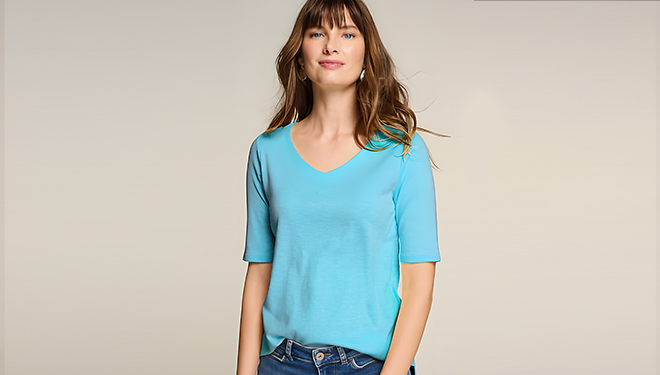
Anatomy & Fit: This collar forms a distinct downward-pointing triangle. It naturally elongates the visual proportions of the human torso. It also balances rounder face shapes beautifully. Wearers often prefer this style for its enhanced breathability and slightly elevated aesthetic.
Print Considerations: Center-chest printing becomes highly restricted here. Large graphics will inevitably distort or run directly into the plunging collar seam. You must adapt your design strategy. It works best for compact left-chest logos, delicate sleeve embroidery, or graphics anchored entirely below the V-point.
Anatomy & Fit: This style features a wider, deeper U-shaped opening. It falls noticeably below the collarbone. It generally offers a looser, more relaxed drape. You will frequently find this silhouette favored in retail-ready collections and women's apparel lines.
Print Considerations: You must lower your graphics significantly to accommodate the missing fabric. Standard print placements will drop off the neckline entirely. It proves highly effective for vertical designs or custom artwork intentionally following the natural curvature of the bust line.
Anatomy & Fit: The Henley defines itself through a prominent 2-to-5 button placket extending down the upper chest. It masterfully blends the casual comfort of a basic tee with a subtle, semi-formal sophistication. It remains a staple in premium casualwear.
Print Considerations: The hardware and thick placket completely disrupt the center-chest print area. Print heads cannot pass smoothly over buttons. Branding must shift away from the center. You should move logos to the left chest, the pocket area, or the broad back of the garment.
Beyond the fundamental basics, niche necklines serve highly specific demographic preferences. They demand careful attention to design placement and decoration techniques to ensure premium results.
This wide, horizontal neckline stretches broadly toward the shoulders. It offers a premium, mid-century aesthetic perfectly suited for business-casual environments or boutique fashion lines. It highlights the collarbones while remaining relatively conservative.
Print risk: Large horizontal neck openings inherently reduce upper-chest fabric stability. The shirt shifts more easily on the wearer. You should pair this style with minimalist sleeve branding or very subtle shoulder embroidery to maintain an elegant look.
These feature high, close-fitting collars. Mock necks sit comfortably against the throat without needing to fold over. Turtlenecks feature extra fabric length designed to fold down upon itself. They offer incredible warmth and a sharp, intellectual profile.
Print risk: Standard chest printing still applies beautifully. However, these styles truly excel when you utilize subtle neck-edge or direct collar embroidery. This subtle branding approach dominates premium corporate workwear and luxury uniforms.
This style features a prominent contrasting color band running along the neckline. It often includes matching contrast bands on the sleeve cuffs. It delivers a highly recognizable, retro athletic aesthetic popularized in the 1970s.
Print risk: The physical print canvas remains identical to a standard crew tee. However, your artwork colors must be carefully color-matched to the contrasting collar. Poor color planning leads to severe visual clashing and an unappealing final product.
Designers originally created this style for military mobility. It is technically a sleeve modification extending all the way to the collar. However, it fundamentally changes the entire shoulder silhouette. It removes the traditional top shoulder seam entirely.
Print risk: The sweeping diagonal seams severely limit standard shoulder prints. The seams disrupt ink coverage and cause misprints. This structure forces you to rely on central chest graphics or specialized, isolated sleeve-panel designs.
The manufacturing method behind the collar dictates how long the shirt will survive regular washing. Understanding these construction techniques helps you avoid cheap garments prone to rapid degradation.
Collar Type | Material & Construction | Performance & Durability |
|---|---|---|
Ribbed Knits | Woven independently. Often blends Spandex or Elastane into the cotton or poly base. | Provides exceptional memory. The neck stretches easily over the head and recovers its shape instantly. It heavily resists "baconing" (unsightly sagging). |
Self-Fabric | Uses the exact identical jersey material as the main body of the shirt. Folded and stitched. | Creates a seamless, modern, and high-fashion drape. However, it typically offers far less structural recovery over time compared to ribbed variants. |
While we primarily view this as a body construction metric, it directly impacts the collar's resting position. Tubular tees weave the fabric in a single continuous tube. They often feature standard, boxier neck drops. They cost less to produce and serve well for massive promotional giveaways.
Side-seamed garments sew separate front and back panels together. This allows manufacturers to create highly tailored, retail-focused neckline variations. It provides a superior overall drape and allows collars to lay much flatter against the upper chest.
Choosing the perfect canvas requires balancing budget, aesthetic goals, and technical print realities. Use this four-step framework to finalize your wholesale procurement strategy safely.
Your primary goal dictates your starting point. If you plan a massive promotional giveaway, default to the standard crew neck. It offers the absolute lowest cost-per-unit and guarantees the highest mass-audience acceptance.
If you need corporate uniforms, evaluate Mock necks, structured Polos, or premium V-necks. These silhouettes provide a sharper, more professional profile suitable for client-facing environments.
Your graphic dimensions act as a strict filter. You must evaluate the physical space your art requires. If you plan to order a Custom T-shirt with a massive 12x14 inch central placement, your choices shrink immediately.
You must eliminate V-necks, Henleys, and deep scoops from your shortlist right away. Those styles lack the continuous flat fabric required to hold oversized central graphics without distortion.
Know exactly who will wear the garment. Fitness and activewear brands should prioritize standard round necks for rugged durability. Alternatively, they can use athletic V-necks for enhanced ventilation during intense workouts.
Fashion and retail brands follow different rules. You should integrate Scoop, Slouchy V-necks, or Boat necks into your line. Pair these modern collars with premium tri-blend or modal fabrics to match current streetwear and boutique trends seamlessly.
Always factor in the complexity of the decoration process. Complex collars increase decoration expenses. Ordering Henleys might force you to abandon a fast, automated center-chest screen print.
Instead, you might need to switch to a slower, localized left-chest embroidery process. This shift inevitably increases labor costs, extends production time, and raises your final price per unit.
Neckline selection serves as a critical technical variable in any custom apparel procurement strategy. The collar choice dictates far more than just a passing aesthetic trend. It rigidly determines the physical viability of your branding and the ultimate lifespan of the garment.
We highly recommend auditing your artwork dimensions before finalizing your blanks. Understand your wearer's daily environment thoroughly before placing a massive bulk order. When in doubt, a high-quality, elastane-ribbed round neck remains the most versatile, universally accepted, and risk-free investment for custom branding.
Take action today by requesting physical sizing samples from your manufacturer. Consult closely with your print provider to verify your chosen neckline will perfectly frame your specific design without costly production errors.
A: A crew neck sits high and snug exactly at the base of the throat. Manufacturers typically build it with a durable ribbed collar. A scoop neck drops significantly lower into a wide "U" shape. This exposes the collarbone and offers a much looser, relaxed drape across the upper chest.
A: The classic crew neck and the subtly squared or boat necks remain universally compatible. They naturally provide structural balance across the shoulders and torso. They achieve this without aggressively highlighting or exposing specific body features, making them incredibly safe for large, diverse groups.
A: Yes, but with heavy technical restrictions. The physical lack of fabric in the center chest means standard oversized graphics will inevitably distort or misprint over seams. You must scale designs down to a left-chest placement or shift them to the lower hem, back, or sleeves.


