
Views: 0 Author: Site Editor Publish Time: 2026-06-29 Origin: Site


Transitioning from off-the-rack garments or basic made-to-measure pieces to true custom tailoring changes your entire perspective on menswear. You quickly realize flashy designer labels matter far less than structural integrity. Many buyers overpay for substandard garments. They expect bespoke quality from entry-level construction. They focus entirely on exterior aesthetics. In doing so, they completely ignore the foundational elements.
The reality is simple. A high-quality custom jacket relies on invisible architecture. It requires functional precision. It is never just about a premium exterior material. In this article, we provide a skeptical, evaluation-focused framework. We want to help you assess genuine craftsmanship. You will learn how to prioritize functional tailoring over cheap aesthetic gimmicks. Finally, we will show you exactly how to confidently vet a tailoring partner. These insights will guarantee your next investment pays dividends for years.
Construction dictates lifespan: Full or half-canvas architecture outweighs high "Super" thread counts in determining a suit’s longevity and drape.
Hand-finished markers signal quality: Look for functional buttonholes, subtle pick stitching, and a natural lapel roll as indicators of technical competence.
Fabric and lining are functional, not just visual: Genuine horn buttons and cupro/bemberg linings are non-negotiable baselines for breathability and wear.
Partner vetting is critical: Whether ordering an individual bespoke piece or sourcing a reliable custom suit manufacturer, assessing their fitting process and pattern-making capability prevents costly missteps.
A beautiful exterior means nothing if the underlying foundation is weak. The internal skeleton of a jacket dictates how it performs. It controls how it drapes. Most importantly, it determines how long it survives in your wardrobe. Let us break down the structural realities you must understand.

You cannot see the inside of a finished jacket collar or chest. However, this hidden layer determines the garment's true value. Tailors use three primary methods to give a jacket its shape.
Fused Construction (The Red Flag)
Fused construction relies on synthetic glue. Manufacturers use heat to fuse an interlining directly to the wool. This saves time. It saves money. However, it completely ruins longevity. The glue eventually breaks down. Dry cleaning accelerates this failure. The fabric begins to bubble or ripple. Tailors call this delamination. You cannot fix it. Fused construction remains unacceptable at premium price points. You should always reject it.
Half-Canvas vs. Full-Canvas
A canvas interlining uses a blend of horsehair, wool, and cotton. Tailors sew this layer between the outer wool and the inner lining. A full-canvas jacket features this layer running from the shoulder down to the hem. The horsehair reacts to your body heat. It absorbs ambient moisture. Over time, it molds specifically to your chest. You get an unparalleled, personalized drape.
A half-canvas jacket offers a durable, budget-conscious compromise. The canvas runs from the shoulder down through the chest. It stops just above the pockets. The lower half uses a light fuse. You still get excellent chest drape. You also avoid bubbling in the most visible areas. This method drastically reduces labor costs while maintaining decent quality.
Suit Construction Comparison
Construction Type | Internal Structure | Longevity | Price Category | Verdict |
|---|---|---|---|---|
Fused | Glued synthetic interlining | Poor (Prone to bubbling) | Budget / Entry-level | Avoid for custom pieces. |
Half-Canvas | Stitched chest, glued bottom | Good (Holds shape well) | Mid-Range | Excellent value compromise. |
Full-Canvas | Fully stitched horsehair layer | Excellent (Molds to body) | Premium / Bespoke | The ultimate standard. |
Evaluating suit fabric and construction requires looking past marketing buzzwords. Mills often use confusing metrics to sell inferior materials.
The "High Super Number" Myth
You will frequently see fabrics advertised as Super 150s or Super 180s. This number refers to the thickness of the individual wool yarn. Higher numbers mean finer, thinner yarns. Many buyers assume a higher number means better quality. This is a massive misconception. High Super fabrics are incredibly delicate. They wrinkle the moment you sit down. They wear out quickly at friction points. We strongly recommend Super 110s through Super 130s for business wear. They provide excellent durability. They recover from wrinkles overnight. They handle high-frequency wear beautifully.
Lining Materials
The interior lining touches your body constantly. It regulates temperature. We establish Cupro or Bemberg as the absolute standard. These materials originate from cotton cellulose. They breathe wonderfully. They slide effortlessly over your dress shirts. You must aggressively reject polyester linings. Polyester traps body heat. It makes you sweat. It ruins the drape of the wool. A polyester lining always indicates severe cost-cutting by the maker.
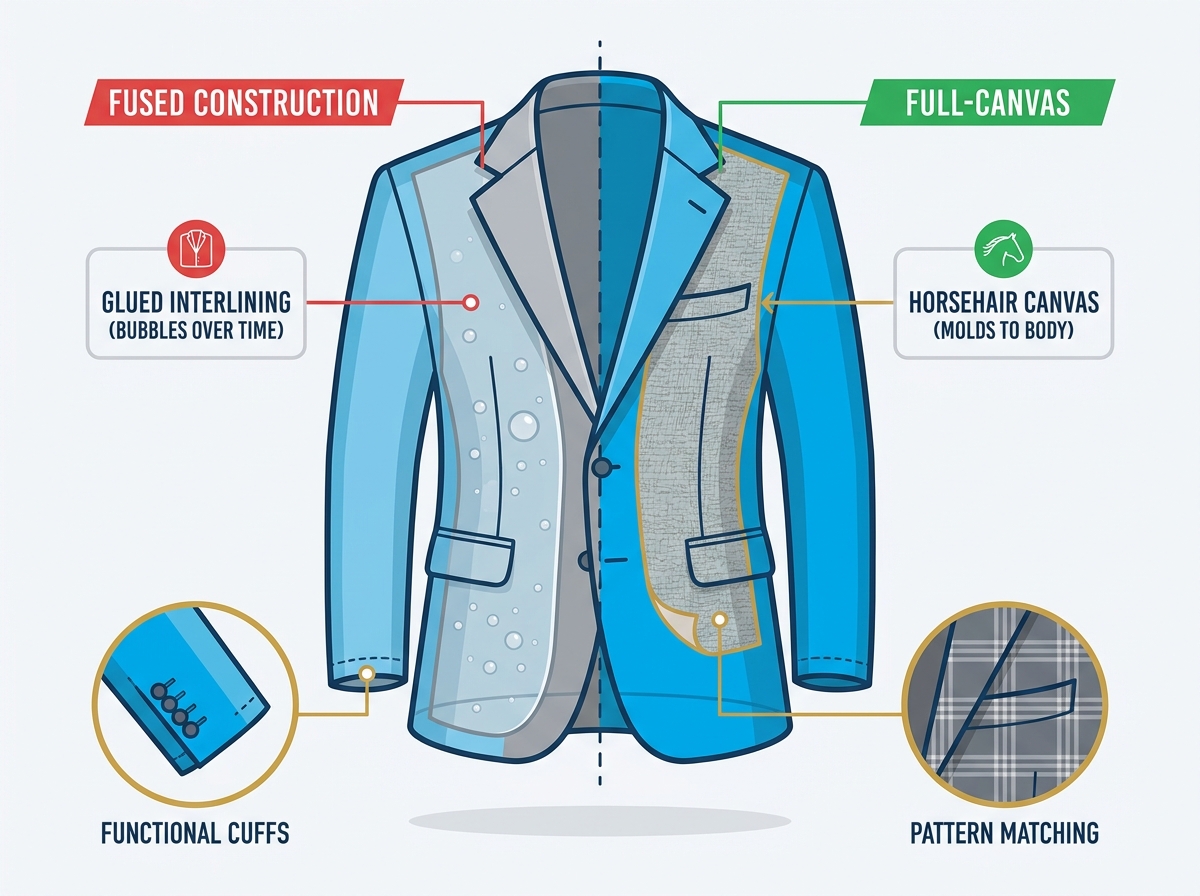
Once you verify the internal architecture, you must inspect the finishing. These essential custom suit details clearly prove the cutter's craftsmanship. They separate true bespoke tailoring from mass-produced imitations.
The lapel roll acts as the signature of a master tailor. A cheap, fused jacket features a flat, lifeless lapel. A factory machine presses a hard crease straight down the edge. It looks completely two-dimensional.
A quality canvas jacket features a gentle, three-dimensional roll. The lapel gracefully arcs from the collar down to the button stance. Tailors achieve this by carefully manipulating the tension of the internal canvas. They pad-stitch the horsehair by hand. It creates a springy, dynamic edge. You should never iron a hard crease into this roll.
Off-the-rack garments use fake sleeve buttons. They simply sew plastic buttons onto a closed seam. This allows the store to alter the sleeve length easily. True bespoke garments feature functional buttonholes. Tailors call them surgeon’s cuffs.
Historically, military surgeons rolled their sleeves up before operating. Today, functional cuffs serve as a universal quality indicator. They prove the tailor cut the sleeves precisely for your arm length. You cannot significantly alter a sleeve once the cutter cuts these holes. Many wearers leave the bottom button unfastened. It serves as a subtle nod to the bespoke process.
Pattern matching strictly tests a cutter's patience and skill. When you order a striped or plaid garment, pay close attention to the seams. The lines must align seamlessly across different panels.
Shoulder seams: The stripes on the sleeve should align with the stripes on the shoulder.
Pocket flaps: The plaid pattern on a pocket flap must perfectly match the jacket body beneath it.
Back seams: The center back seam should create a flawless chevron effect with the pattern.
Poor pattern matching creates a jarring, disjointed appearance. It proves the factory prioritized fabric yield over visual harmony. Always inspect this detail closely.
Pick stitching involves a subtle thread running along the edges of the lapels and pockets. Tailors traditionally did this entirely by hand. The stitches look slightly irregular. They sink deep into the wool.
This detail serves a functional purpose. It keeps the lapel edge flat and sharp. It prevents the fabric layers from rolling outward. Today, special AMF machines can replicate this look. Regardless of the method, pick stitching demonstrates artisanal attention. It adds a beautiful, textured border to the garment.
Customization options can easily overwhelm new buyers. Tailors offer hundreds of distinct modifications. You must distinguish between functional upgrades and useless vanity additions.
Certain features significantly improve your daily comfort. We consider these high-ROI (Return on Investment) customizations. They solve real wardrobe problems.
Side Adjusters Over Belt Loops
We advise skipping belt loops entirely on tailored trousers. Belts add unnecessary bulk to your waist. They visually cut your body in half. Instead, request side adjusters. These small buckles sit on the waistband. They allow you to tighten or loosen the trousers instantly. This accommodates minor weight fluctuations. It maintains a clean, unbroken waistline. It enhances the drape of the trouser leg.
Gusseted Armholes
Most mass-market jackets feature low armholes. They do this to fit a wider range of body types comfortably. However, a low armhole severely restricts your movement. When you lift your arm, the entire jacket pulls up. True custom tailoring uses higher, tighter armholes. A high armhole sits close to your armpit. It allows your arm to move independently. The jacket body remains perfectly still. You stay comfortable all day.
Internal Pocket Architecture
Standard pockets often fail modern users. They sag under the weight of heavy smartphones. You can request purpose-built pocket architecture. Ask the tailor to size a specific pocket for your exact device. They can reinforce the internal stitching. This prevents the exterior of the jacket from sagging. It keeps the silhouette crisp.
Some tailors use loud aesthetics to mask poor foundational work. You should approach vanity details skeptically.
Avoid overly contrasting buttonhole threads. Bright red stitching on a navy sleeve looks cheap. It screams for attention. Similarly, avoid loud, novelty silk linings. A neon skull print inside your jacket might seem fun initially. It usually ages terribly. These gimmicks often distract the buyer. They keep you from noticing glued construction or poor fit. Stick to classic, understated elegance.
Finding a reliable tailoring partner requires strict due diligence. You must evaluate their technical capabilities. You must understand their specific supply chain.
When you vet a custom suit manufacturer, you must evaluate their pattern origins. Ask them exactly how they create your pattern. Do they use a unique block drafted from scratch? That defines true bespoke tailoring. Or do they simply modify an existing factory template? That represents made-to-measure. Both methods have value. However, you must know what you are paying for.
Furthermore, niche expertise matters deeply. If you source garments for female clients, standard menswear factories often fail. You must ensure you work with a dedicated women’s suits manufacturer. Women's tailoring requires entirely different structural blocks. The tailor must account for bust volume and distinct hip drapes. Merely scaling down a men's pattern creates a terrible, boxy fit. Specialized manufacturers understand these complex anatomical nuances.
A beautiful fabric cannot save a bad fit. You must evaluate their fitting process. A legitimate bespoke partner requires at least one "basted fitting." During this stage, the garment remains unfinished. The tailor holds the panels together with loose white cotton thread. There are no linings. There are no buttons.
This basted stage allows the tailor to refine the structural drape. They assess how the canvas sits on your shoulders. They rip seams open right in front of you. They pin them back together perfectly. If a tailor promises a fully finished bespoke garment without an intermediate fitting, they are lying. They are running a made-to-measure operation.
Reputable makers take immense pride in their supply chain. They will openly disclose their sources. Ask them about their fabric mills. You want to hear names like Vitale Barberis Canonico (VBC), Loro Piana, or Holland & Sherry. They should willingly show you the mill labels.
Inspect the hardware sourcing as well. Quality makers use genuine horn or corozo nut buttons. They never use cheap plastic. Plastic buttons crack at the dry cleaner. Horn buttons feature unique, natural marbling. They last a lifetime. Transparent tailors gladly discuss these small components.
Understanding cost mechanics protects you from bad investments. A suspiciously cheap garment always hides catastrophic shortcuts.
A tailored garment's price breaks down into three core components. You pay for the raw fabric cost. You pay for the internal canvas materials. Finally, you pay for the highly skilled labor and fittings.
Premium European wools cost significant money per meter. Horsehair canvas requires expensive hand-stitching. If a maker offers a price far below the market average, the math fails. Prices below a certain threshold mathematically require fused construction. Alternatively, they rely on unethical sweatshop labor. You cannot shortcut the cost of quality.
Even with good budgets, projects fail due to miscommunication. You must manage these risks proactively.
Fit preference terminology causes massive confusion. A "slim fit" means something entirely different to a British tailor versus an Italian cutter. You must bring visual references. Show them photographs of how you want the trousers to drape. Never rely purely on adjectives.
Inaccurate self-measuring poses another huge risk. Many online-only providers ask you to measure yourself at home. This almost always ends poorly. You cannot measure your own shoulder slope accurately. Without localized tailoring support, online custom programs often result in unwearable garments.
Use this rigorous checklist before paying a deposit:
Request macro photos of their lapel roll and a sample of their interior canvas layer.
Verify the exact fabric mill and confirm the internal lining uses Cupro or Bemberg.
Confirm their alteration policy post-delivery. (A good tailor always covers the first round of minor tweaks).
Inspect the buttonholes on a sample garment to ensure they cut them cleanly without fraying.
Check the shoulder seams on a patterned sample piece for proper pattern matching.
The true value of a tailored garment lies deep within its internal canvas. It reveals itself in precise pattern matching. It shines through the functional intent behind every hand-stitched detail. Evaluating construction separates a genuine investment piece from a disposable fashion item. You now possess the framework to assess structural integrity confidently. You understand why side adjusters beat belt loops. You know why fused interlinings remain unacceptable.
Your next actionable step is straightforward. Book a physical consultation. Request to view their physical fabric swatches. Ask the cutter to provide a finished sample garment. Inspect the lapel roll. Check the stitching tension. Verify the buttonhole finishing. Only commit to a full commission once you verify these essential details in person.
A: The most important details are the precise fit and the internal canvas construction. Without a strong horsehair foundation and an accurate pattern block, superficial aesthetic details simply do not matter. The canvas controls the drape and dictates the overall lifespan.
A: You can identify high quality by checking for a natural, three-dimensional lapel roll. Look for functional surgeon's cuffs on the sleeves. Verify they use genuine horn hardware instead of plastic. Finally, check for seamless pattern matching across the shoulder and back seams on patterned fabrics.
A: Bespoke tailoring creates a brand new, unique paper pattern from scratch for your specific body. It requires multiple mid-process basted fittings. Made-to-measure (MTM) simply modifies an existing, pre-graded factory template. MTM usually skips the raw basted fitting stage entirely.
A: Generally, no. Tailoring experts prefer side adjusters or interior suspender buttons. Belts add unnecessary bulk to the midsection and break the visual line of the waist. Side adjusters provide a much cleaner drape while still allowing precise, instant waist customization.


