
Views: 0 Author: Site Editor Publish Time: 2026-06-30 Origin: Site


Transitioning from small-batch production or dropshipping to ordering bulk custom dresses is a critical threshold. Here, fashion brands either secure their profit margins or expose themselves to severe inventory risks. Committing to large-run manufacturing requires moving past mere aesthetic design. You must focus intensely on unit economics, supply chain reliability, and stringent quality assurance. Ignoring these factors often leads to dead stock and cash flow crises.
Successfully scaling your dress line requires a hardened evaluation framework. You need this framework to vet manufacturing partners carefully. You must also lock in material standards and enforce strict production timelines before any capital changes hands. This comprehensive guide will walk you through the precise steps to navigate these challenges, ensuring your next major inventory investment yields high-quality garments and profitable returns.
Minimum Order Quantities (MOQs) should align with your proven sales velocity, not just the manufacturer’s lowest price tier.
Dress fabric selection dictates both your production timeline and final profit margin; securing continuous supply is just as important as the initial textile cost.
Vetting a custom dress manufacturer requires looking past marketing claims to audit their sampling process, compliance certifications, and defect resolution policies.
A locked-in "Tech Pack" and multiple physical sampling rounds are non-negotiable prerequisites for bulk dress production.
Scaling a clothing brand requires strict financial discipline. You cannot simply chase the lowest per-unit manufacturing cost. Instead, you must carefully balance production savings against the carrying cost of unsold inventory.
Many emerging brands make a critical mistake during initial procurement. They over-order to unlock cheaper pricing tiers. This approach ties up capital. It also increases warehouse storage fees and forces aggressive markdowns later. True success means balancing the lowest cost per unit against the carrying cost of unsold goods. You should only order what your data proves you can sell within a standard seasonal cycle.
Manufacturers do not set MOQs arbitrarily. Factories enforce Minimum Order Quantities based on fabric roll yields rather than simple unit counts. Suppliers purchase raw textiles in large standardized rolls. If one roll yields 300 dresses, the factory will typically set an MOQ of 300 units. They want to avoid holding leftover fabric.
Boutique brands can creatively negotiate these constraints. You can request split-sizing or split-colorways within a single MOQ bracket. This strategy allows you to diversify inventory without increasing total volume. For example, you might split a 300-piece MOQ into 150 black dresses and 150 navy dresses, spread across standard sizes. This mitigates inventory risk while satisfying the factory's raw material requirements.
Relying solely on the factory quote will skew your financial projections. You must move beyond the Ex-Works (EXW) price. The EXW price only covers the garments sitting on the factory floor. It does not include getting the products to your warehouse.
To determine your actual gross margin, you must calculate the true landed cost. This calculation involves adding several crucial expenses:
Freight and Shipping: Ocean freight takes longer but costs less. Air freight is fast but expensive.
Customs Duties and Tariffs: Import taxes vary wildly depending on the fabric composition and country of origin.
Cargo Insurance: This protects your investment against transit damage or container loss.
Third-Party QA Fees: Hiring independent inspectors before shipment prevents costly returns.
Factoring in these hidden layers reveals the true financial commitment required for large-scale procurement.
Proper dress fabric selection dictates both your production timeline and your final profit margin. Securing continuous supply is just as important as negotiating the initial textile cost. A brilliant design will fail if the chosen material performs poorly during bulk cutting.
Apparel brands generally choose between two sourcing avenues. You can use in-stock market fabrics or develop custom-milled textiles. In-stock fabrics are readily available in local textile markets. They allow for rapid prototyping and fast turnaround times. However, suppliers rarely guarantee long-term availability for specific dye lots.
Custom-milled textiles offer exclusive colors, specific thread counts, and unique compositions. However, custom milling increases lead times by 30-45 days. You must factor this substantial delay into your seasonal launch calendar. If you run out of stock unexpectedly, replenishing custom-milled dresses will take months.
Sourcing Method | Lead Time Impact | Continuity Risk | Best Used For |
|---|---|---|---|
In-Stock Market Fabric | Fast (Ready immediately) | High (May discontinue anytime) | Fast-fashion, trendy seasonal runs |
Custom-Milled Textile | Slow (Adds 30-45 days) | Low (Guaranteed reproduction) | Core collections, signature silhouettes |
You must rigorously validate material performance before bulk cutting begins. This includes testing fabric weight (GSM), drape, and shrinkage rates. Garments shrink during washing. If you do not account for shrinkage during the pattern-making phase, the final dresses will not fit your customers properly.
Regulatory compliance is equally crucial. You must verify colorfastness to ensure dyes do not bleed onto skin or other garments. Furthermore, you must ensure compliance with regional textile regulations. Examples include REACH in the European Union and CPSIA in the United States. Failing these compliance checks can result in seized shipments at customs.

Textile manufacturing involves complex chemical processes. Dye lots frequently vary between production runs. To mitigate consistency risks, brands must request "top of production" (TOP) fabric swatches. You must compare these swatches to your original pre-production sample. This ensures the bulk fabric matches the approved baseline perfectly before the factory begins cutting the rolls.
Partnering with the right custom dress manufacturer requires looking past slick marketing claims. You must audit their sampling process, review compliance certifications, and understand their defect resolution policies.
Choosing the right production model depends entirely on your internal brand resources. You generally have three options:
Direct Factory: You deal directly with the facility. This offers the lowest margins but requires you to manage communication, QA, and logistics yourself.
Trading Company: These middlemen source factories for you. They offer better communication and aggregate orders, but they take a margin cut.
Full-Package (FPP) Manufacturer: FPP providers handle everything from pattern making and sourcing to final sewing. This is ideal for brands lacking an in-house technical team.
A rigorous capability check is mandatory. Do they specialize in woven evening gowns, knit casual dresses, or stretch activewear? Machinery dictates capability. A factory equipped for heavy denim cannot properly sew delicate silk chiffon. Always ask for a detailed machinery list.
Compliance and ethics also define a reliable partner. Requesting independent audit reports helps verify labor practices and avoid brand reputation damage. Look for certifications like WRAP, BSCI, or SMETA. These frameworks ensure the facility meets international standards for safe working conditions and fair wages.
When filtering potential partners, prioritize manufacturers willing to provide references from similar-sized brands. Speaking with their current clients reveals insights about communication habits and deadline adherence.
Beware of partners who promise unrealistic lead times. Quality manufacturing takes time. Additionally, avoid factories that readily accept orders without reviewing a comprehensive Tech Pack. A professional manufacturer will always review your technical drawings, measurement grades, and bill of materials before quoting a final price.
Transitioning into bulk dress production requires patience and rigorous oversight. A locked-in Tech Pack and multiple physical sampling rounds are non-negotiable prerequisites.
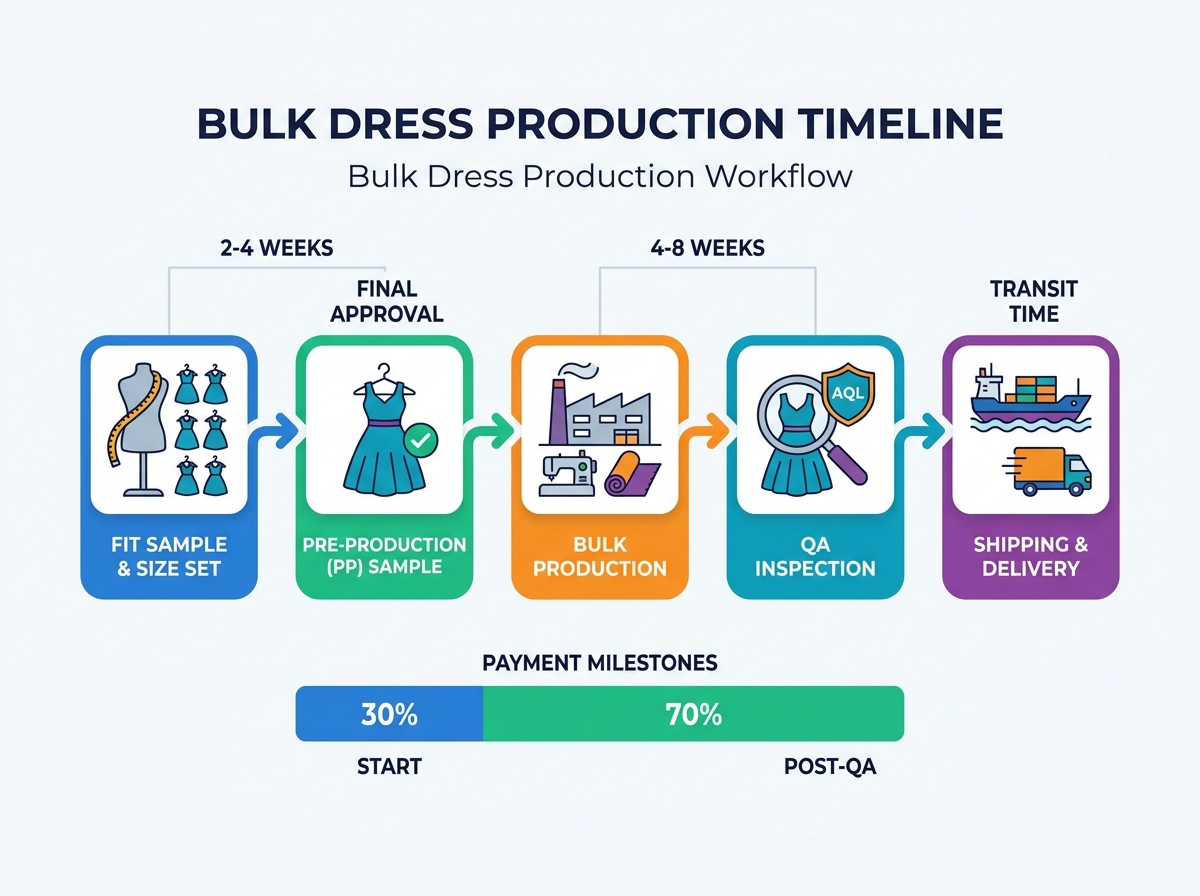
Never skip the sampling phases. Rushing straight into bulk production usually results in thousands of unwearable garments. Follow a strict prototyping funnel:
Fit Sample: You test the initial pattern using available substitute fabrics. The goal here is evaluating the silhouette and seam placement.
Size Set Sample: Once the base fit is approved, the factory creates samples grading the pattern across all intended sizes (e.g., XS-XXL). This ensures proportions scale correctly.
Pre-Production (PP) Sample: This is the final, contract-binding benchmark. The factory must use the actual bulk fabric, custom dyes, and final trims. Do not approve mass production until the PP sample is flawless.
Optimism has no place in supply chain management. You must map realistic lead times. Expect 2-4 weeks for comprehensive sampling iterations. Actual production will take another 4-8 weeks. Finally, add transit time for shipping.
You must also factor in significant buffers for regional manufacturing holidays. For example, the Chinese New Year effectively shuts down Asian production hubs for up to four weeks. Planning your launch around these blackouts is essential for maintaining inventory flow.
Implementing Acceptable Quality Limit (AQL) standards gives you a mathematical framework for evaluating bulk runs. AQL defines the maximum number of defective units permitted in a batch before the entire shipment is rejected.
Utilizing third-party inspection agencies prior to container loading serves as a necessary insurance policy. These inspectors visit the factory, pull random boxes, and measure garments against your approved Tech Pack. Identifying errors at the factory level allows for immediate re-working. Finding errors after the container arrives at your local warehouse is financially devastating.
Handshake deals do not work in global manufacturing. You must protect your capital and intellectual property through binding legal frameworks.
Your payment terms should strictly tie to verifiable production milestones. A standard, secure structure involves paying 30% upfront to cover raw materials. You then pay the remaining 70% upon successful third-party QA inspection. Never pay 100% upfront. Retaining the final balance gives you crucial leverage if quality issues arise.
The contract must include clear clauses defining defect tolerance percentages. It must also outline specific chargebacks for rejected units. If the factory produces a batch with a 10% defect rate when the contract stipulated 2.5%, they must absorb the cost of the ruined materials.
Fashion designs are easily stolen. Securing NNN (Non-Disclosure, Non-Use, Non-Circumvention) agreements is vital. An NNN goes beyond a standard NDA. It prevents the manufacturer from using your dress designs for other clients. It also legally prohibits them from selling your overstock or rejected dresses to unauthorized liquidators or competitor platforms. Protecting your brand exclusivity is just as important as securing a low unit cost.
Ordering dresses in volume fundamentally shifts a brand's role from a creative designer to a meticulous supply chain manager. Your success no longer relies solely on aesthetics. It depends entirely on rigorous vetting, precise technical documentation, and proactive risk mitigation. Securing high-quality output requires respecting the complexities of MOQs, textile sourcing, and rigorous quality assurance protocols.
Before initiating outreach to new suppliers, finalize your Tech Packs completely. Establish strict margin requirements and define your timeline constraints. Use these solid metrics to confidently filter out incompatible suppliers during your very first sourcing conversations. By taking these methodical steps, you build a resilient, profitable, and scalable fashion business.
A: Typically ranges from 100 to 500 pieces per style/color, depending on whether the fabric is sourced from open markets or custom-milled.
A: Expect to pay 2x to 3x the projected bulk unit price, which is standard practice to cover setup time and is often deductible from the final bulk invoice.
A: CMT (Cut, Make, Trim) requires the brand to source and supply all materials; FPP (Full Production Package) means the manufacturer handles sourcing, pattern making, and production end-to-end.
A: Do not pay the final balance until a third-party inspector validates the goods at the factory level against your approved AQL standard.


