
Views: 0 Author: Site Editor Publish Time: 2026-06-09 Origin: Site


Transitioning from design concepts to physical inventory is the highest-risk phase for any emerging apparel brand. Creating beautiful sketches feels deeply rewarding for founders. However, turning those designs into tangible garments often exposes new businesses to harsh operational realities. Without a solid supply chain, great ideas never reach the consumer.
Many founders burn their initial capital on mismatched manufacturing partners. This specific misstep directly results in unsellable inventory, missed launch deadlines, or quality control disasters. Navigating the murky waters of global apparel production often leaves inexperienced brand owners highly vulnerable to predatory practices or simple incompetence.
Securing a reliable manufacturing partner requires treating the selection process as a strategic B2B acquisition. You cannot afford to choose an assembly partner based solely on a friendly email exchange. This guide provides a skeptical, evidence-based framework for evaluating, testing, and onboarding a production partner. We will outline exactly how to protect your capital and your brand reputation.
Preparedness is mandatory: Do not approach manufacturers without finalized Tech Packs and clear volume projections.
MOQs must align with cash flow: Choose partners whose Minimum Order Quantities (MOQs) support your launch budget, not just the lowest per-unit cost.
Sampling is an interview: Treat the prototype phase as a test of communication, precision, and reliability, not just a product milestone.
Contracts protect both sides: Establish clear Service Level Agreements (SLAs) covering defect rates, lead times, and intellectual property ownership before paying a deposit.
Factories operate strictly on margins and daily efficiency. Their entire business model relies on moving projects smoothly from the cutting room to the shipping dock. If you approach them with vague ideas instead of standardized documents, they will view you as a liability. They will either inflate pricing to cover the massive communication gap or politely decline your project altogether. Finding a trustworthy startup clothing manufacturer means you must first look internally and ensure your own documentation is flawless.
Detailed blueprints are strictly non-negotiable in this industry. We call these blueprints Tech Packs. You cannot simply send a factory a photograph of a competitor's jacket and ask them to copy it. A professional Tech Pack removes all guesswork and acts as your primary communication tool. Before initiating outreach, ensure you have these core elements ready:
CAD Sketches: Flat, technical drawings showing the front, back, and interior details.
Bill of Materials (BOM): An exhaustive list of every single physical item required to make the garment, down to the exact thread weight and zipper manufacturer.
Grading Rules: Specific measurements dictating how the pattern scales from a size small up to a size extra-large.
Construction Callouts: Detailed instructions on stitching types, seam allowances, and label placements.
Next, you must decide on your material sourcing strategy. Founders generally choose between Cut, Make, Trim (CMT) and Full Production Package (FPP). CMT requires you to source and ship all fabrics and trims to the facility yourself. FPP allows the factory to leverage their existing supply chain networks to source everything for you. FPP is the standard approach for most emerging brands because it simplifies logistics. However, it carries a premium markup. The factory essentially charges a management fee for handling the raw materials.
Finally, always budget for the hidden costs of production. Do not calculate your profit margins based purely on the quoted per-unit cost of the garment. You must accurately factor in tooling fees, pattern grading charges, ocean or air freight shipping, import tariffs, and multiple sample iterations. Ignoring these expenses will destroy your cash flow before your inventory even arrives.
Your search begins with defining geographic parameters. You must weigh the logistical benefits of staying local against the economic advantages of going global. Selecting a reliable clothing factory for startups requires a clear understanding of what you actually need right now versus what you might need in three years.
Domestic manufacturing often provides easier communication, faster shipping speeds, and lower Minimum Order Quantities (MOQs). This makes local partners ideal for testing new concepts quickly. Conversely, overseas manufacturing offers highly specialized capabilities, vast fabric sourcing networks, and significantly lower unit economics at scale. A simple comparison reveals the trade-offs:
Evaluation Factor | Domestic Production | Overseas Production |
|---|---|---|
Minimum Order Quantities (MOQ) | Generally lower (50-150 units) | Generally higher (300-500+ units) |
Communication & Time Zones | Immediate, no language barriers | Delayed responses, potential language gaps |
Per-Unit Cost (At Scale) | Significantly higher | Significantly lower |
Shipping Speed & Logistics | Fast ground shipping, no customs | Slower ocean freight, import duties apply |
When interviewing potential partners, conduct a strict MOQ reality check. Ask factories exactly how they define their minimums. A facility quoting an MOQ of 500 units might apply that per style, per color, or even per size. If they require 500 units per size across four sizes, your actual commitment suddenly jumps to 2,000 units. Clarify these terms immediately.
Production capabilities also dictate compatibility. Does their machinery actually match your product category? Activewear requires specialized flatlock stitching machines for stretch mobility. Woven outerwear requires entirely different equipment. Do not assume a facility can produce yoga pants simply because they make great denim jackets.
You must also enforce compliance and ethics standards. Request verifiable certifications like WRAP (Worldwide Responsible Accredited Production), ISO standards, or Oeko-Tex for fabric safety. Never accept vague, verbal assurances of ethical practices. Ask for the actual certificate documents and check their validity dates.
Finally, track their communication cadence closely. Assess their typical response times during initial inquiries. If an overseas partner struggles with English proficiency, gauge their willingness to utilize standardized project management tools or visual communication aids. Poor communication during the quoting phase guarantees catastrophic miscommunications during mass production.
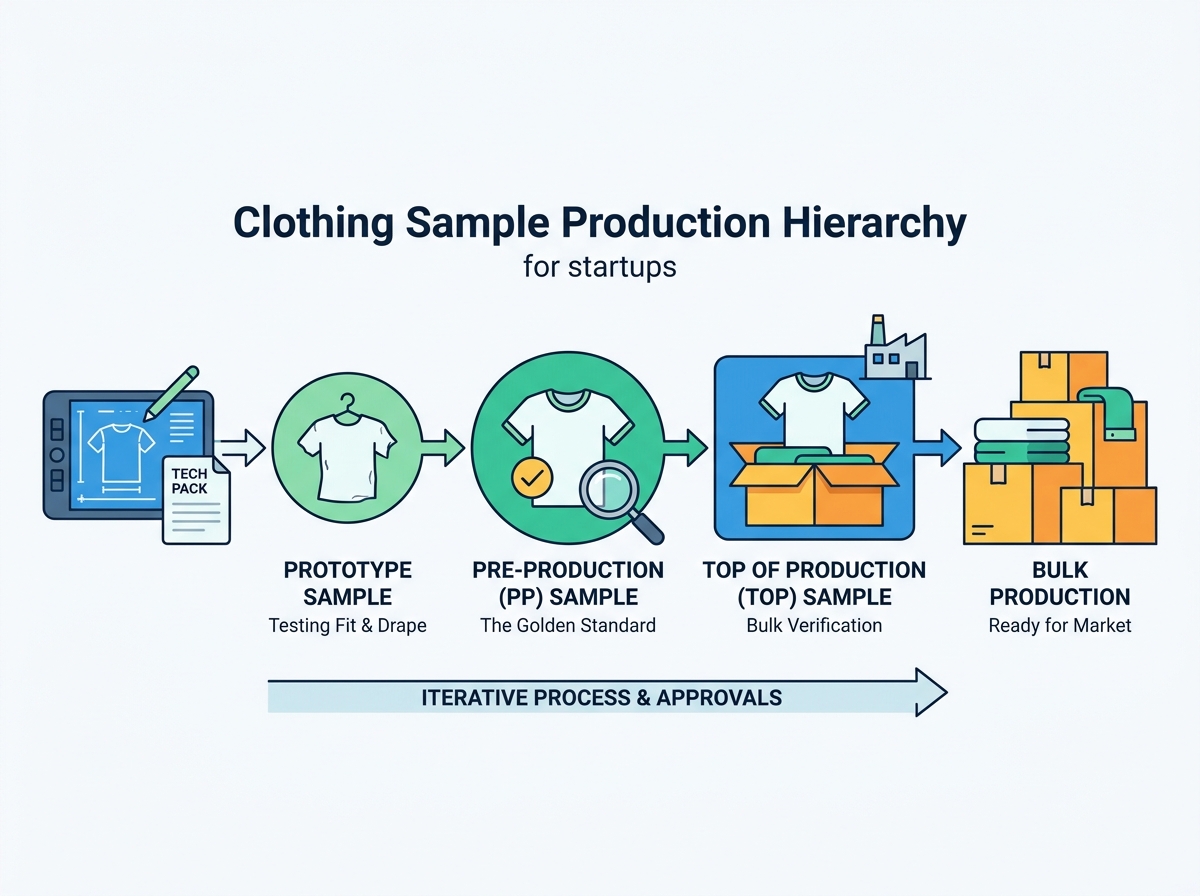
The transition from a flat, two-dimensional sketch to a physical, three-dimensional garment rarely works perfectly on the first try. Implementing clothing sample production is arguably the most frustrating step. Startups frequently rush this delicate phase because they feel immense pressure to launch. Rushing directly leads to bulk production failures, unsellable stock, and ruined customer trust.
You must understand the standard sampling hierarchy to manage your own expectations. Production relies on progressive refinement. Treat each stage as a distinct milestone:
First Fit / Prototype Sample: This initial garment simply tests the basic pattern, overall silhouette, and drape. Expect glaring imperfections here. It exists solely to prove the concept works in the physical world.
Pre-Production (PP) Sample: This represents the exact, uncompromising standard for your bulk production. It must use the correct bulk fabric, exact trims, and final finishing methods. Never approve your bulk order without a flawless PP sample in your hands.
Top of Production (TOP) Sample: The factory pulls this unit directly off the assembly line from the very first bulk run. It verifies that the mass production matches the approved PP sample perfectly.
Treat this entire prototyping phase as an extended job interview. You are actively evaluating the factory during this period. Track their strict adherence to promised timelines. Monitor exactly how they handle your requested revisions. Do they push back aggressively, or do they offer constructive solutions? Evaluate their transparency when a specific fabric or trim suddenly becomes unavailable. A great partner suggests viable alternatives immediately. A bad partner simply substitutes cheap materials without asking for your permission.
Sales representatives at manufacturing facilities excel at painting optimistic pictures. You must move past these polished sales pitches to uncover operational realities. Asking tough, scenario-based questions demonstrates your own trustworthiness and industry knowledge. It shows them you are a serious buyer, not an amateur hobbyist.
Always clarify defect and rework policies before transferring any funds. Ask them directly: "If the final bulk order deviates from our approved PP sample by more than the accepted tolerance margin, who covers the cost of remaking the goods or paying for the freight?" A reputable partner will have a clear, documented policy for handling their own mistakes. Evasive answers here signal extreme risk.
Demand lead time transparency. Ask them: "What is your standard production lead time, and exactly how do local holidays impact that schedule?" For example, the Chinese New Year halts Asian manufacturing completely for several weeks. Factories often experience immense backlogs directly before and after this holiday. You must build these seasonal blackout periods into your launch calendar.
Investigate their subcontracting realities. Ask bluntly: "Do you manufacture everything entirely in-house, or do you subcontract overflow work to secondary facilities during peak seasons?" Unauthorized subcontracting introduces severe quality control risks. You lose all visibility into worker conditions, machinery quality, and material handling. If they do subcontract, you must insist on auditing those secondary facilities as well.
Evaluating a partner requires looking at your own roadmap. A factory that executes perfectly on low-volume, straightforward basics might fail spectacularly when you introduce complex garments later. Scalability dimensions matter immensely. Transitioning from basic setups to cut-and-sew outerwear strains different operational muscles.
Conduct a thorough capacity assessment early in the relationship. Ask about their maximum monthly output. Can they seamlessly grow with your brand from 300 units a month up to 3,000 units without suffering a noticeable drop in quality? Facilities with limited sewing lines often struggle to scale up quickly, forcing you to find a second facility right when your brand is gaining momentum.
Discuss your plans for product line expansion. If your launch strategy begins simply with custom T-shirt production, do not assume they can handle your future winter jacket line. Ask to see physical samples of their most complex past work. Request examples of their denim construction, heavy knitwear, or technical waterproof fabrics. Examining their high-end capabilities helps you gauge their long-term viability as a single-source supply chain partner.
Knowing when to walk away saves you far more money than negotiating a cheaper unit price. Establish strict shortlisting logic to disqualify dangerous vendors immediately. Disqualify any candidate who exhibits these distinct risk markers during the negotiation phase.
Walk away if they refuse to sign an NNN (Non-Disclosure, Non-Use, Non-Circumvention) agreement. While standard NDAs offer mild protection, an NNN is crucial when dealing with overseas factories. Refusal to sign indicates a high risk of your designs being quietly sold to your competitors or uploaded to mass-market wholesale platforms.
Beware the "yes to everything" syndrome. Desperate factories will promise you the world just to secure your deposit. A genuinely trustworthy factory pushes back. They will tell you when a timeline is impossible. They will warn you if a chosen fabric is incompatible with a requested stitch type. Constructive friction is a sign of experience.
Reject opaque pricing structures immediately. If a factory refuses to itemize their costs, walk away. You deserve to see the breakdown of fabric costs, labor expenses, trim prices, and internal shipping fees. Arbitrary, bundled pricing often hides massive markups and prevents you from optimizing your costs in future production runs.
Finally, never proceed without visual proof of the facility. If a factory expresses inability or outright refusal to provide a live video tour of their production floor, they are likely a middleman posing as a manufacturer. You need to see the actual sewing lines, the cutting tables, and the storage areas to verify their legitimacy.
Vetting a clothing factory is fundamentally an exercise in risk mitigation. Success in apparel manufacturing relies heavily on standardized documentation, rigorous prototype sampling, and legally binding agreements. Treating the factory as a strategic extension of your own business ensures a smoother path from flat sketch to physical inventory.
Your immediate next-step actions should focus on preparation. Finalize your Tech Packs down to the millimeter. Create a qualified shortlist of three to five candidate factories and initiate a formal Request for Quotation (RFQ) process. Most importantly, do not commit your capital to a bulk order until you hold an approved Pre-Production sample in your hands and have confirmed it in writing.
A: Development samples generally cost two to five times the anticipated bulk unit price. Factories charge this premium to cover the intensive labor required to setup machines for a single item. Fortunately, many reputable manufacturers will deduct this sample cost from your final bulk invoice once you place the larger mass production order.
A: MOQs vary heavily by region and facility type. For high-end domestic factories, you can typically expect minimums ranging from 50 to 100 units per style. For overseas manufacturers offering lower unit prices, standard MOQs usually start between 300 and 500 units per style and colorway.
A: While you can use standardized templates, basic legal protection is crucial before transferring large funds. A lawyer ensures your Service Level Agreements (SLAs) correctly dictate terms regarding accepted defect rates, delayed shipment penalties, and intellectual property ownership. Protecting your brand upfront is much cheaper than fighting international disputes later.
A: A direct manufacturer owns the physical factory and sewing lines. A sourcing agent is a middleman who leverages their network to find appropriate factories for you. Agents take a management cut, but they provide massive value for inexperienced startups by navigating language barriers, managing daily quality control, and handling complex logistics.


