
Views: 0 Author: Site Editor Publish Time: 2026-10-13 Origin: Site


Commissioning a personalized garment feels incredibly rewarding. It represents a serious financial commitment for most buyers. Poor material choices or a subpar internal framework can quickly ruin your investment. A poorly built garment often blisters, loses shape, or wears out prematurely. These flaws completely negate the value of traditional tailoring. Stepping into a tailor shop without basic knowledge often leads to expensive mistakes. Educating yourself changes the dynamic entirely. You become an empowered buyer capable of making informed decisions. Whether you buy pieces for a personal wardrobe or evaluate partners for a private label, you need technical knowledge. Understanding tailoring mechanics protects your wallet and guarantees a better fit. This guide provides a clear framework to evaluate textile performance and decode tailoring terminology. You will learn how to select specifications perfectly aligned to your budget, local climate, and durability needs.
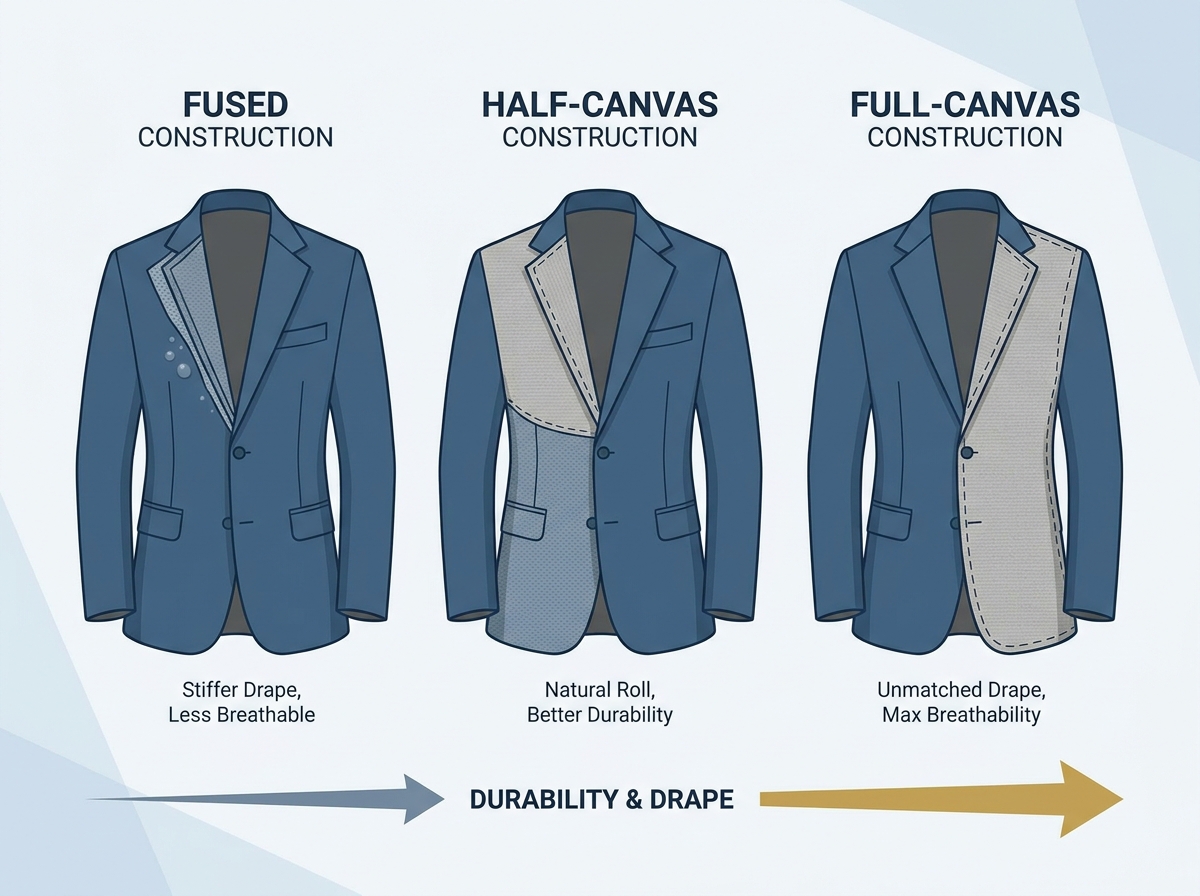
The internal framework acts as the skeleton of your jacket. It dictates how the garment drapes, moves, and ages over time. Proper suit construction remains far more important than the exterior textile. You must choose a foundation matching your expectations for longevity. The success of your garment depends entirely on these hidden layers.
Manufacturers create fused garments by gluing interfacing directly to the outer wool. They use extreme heat and industrial adhesives to bond these layers quickly. This method requires minimal tailoring skill and reduces production time drastically.
Outcomes & Risks: This technique creates a stiffer drape and significantly reduces breathability. You face a high risk of blistering over time. Blistering occurs when the glue degrades and separates from the wool. Dry cleaning chemicals accelerate this irreversible bubbling effect.
Verdict: We consider this acceptable only for fast-fashion items or highly budget-constrained uniform programs. Experts generally do not recommend fusing for high-return tailoring investments.
This method represents the value sweet spot for most buyers. Tailors sew a layer of horsehair canvas into the chest and lapel sections. They only apply glued fusing to the lower body of the jacket.
Outcomes & Risks: Horsehair possesses a unique ability to mold to your body. Heat and moisture from daily wear help it remember your exact chest shape. This provides a beautiful, natural roll to the lapel. It extends the garment life dramatically without demanding the full manual labor cost of a completely hand-stitched piece.
Verdict: Consider this the absolute baseline requirement for any quality tailoring commission.
The gold standard involves a floating canvas layer running from the shoulder down to the hem. Tailors stitch this layer loosely to the wool, allowing independent movement. Artisans use thousands of tiny pad stitches to shape the lapels by hand.
Outcomes & Risks: It delivers unmatched drape and maximum breathability. The floating canvas distributes tension evenly across the entire jacket. It eliminates stiff spots and glue degradation risks entirely. The primary downside involves higher costs. Traditional canvases also added weight, though modern suppliers now produce ultra-lightweight versions to mitigate the bulk.
Verdict: This represents the ideal choice for premium investments, bespoke commissions, and high-end luxury retail offerings.
Picking the perfect custom suit fabric requires balancing aesthetic desires against practical realities. You must categorize textile solutions based on your specific use-case, local climate, and maintenance habits.
The S-System measures the fineness of individual wool fibers. Many buyers fall into a common marketing trap. They assume higher numbers automatically equal a superior jacket. The reality proves much different.
Textiles rated Super 100s to Super 130s are highly durable and naturally wrinkle-resistant. We highly recommend them for heavy rotation in your weekly wardrobe. Conversely, Super 150s to Super 180s feel incredibly silky but remain delicate. They snag easily, wrinkle quickly, and wear out faster. Reserve these ultra-fine options strictly for occasional formal wear.
Chart: Wool Super Number Performance Comparison
| Super Number Range | Texture & Feel | Durability | Ideal Use Case |
|---|---|---|---|
| Super 100s – 120s | Sturdy, slightly textured | Excellent | Daily wear, heavy rotation |
| Super 130s – 140s | Smooth, balanced | Good | Executive business, frequent wear |
| Super 150s – 180s+ | Ultra-silky, fragile | Low | Weddings, occasional formal events |
Fabric weight dictates your comfort level across different seasons. Choose wisely based on your geographic location and office temperature. You have three primary categories to consider.
Table: Fabric Weight Seasonal Guide
| Weight Category | Ounce Range | Typical Materials | Best Season |
|---|---|---|---|
| Lightweight | 7 - 9 oz | Linen, Fresco, Cotton | Summer / High Humidity |
| Mid-weight | 9 - 11 oz | Worsted Wool, Mohair Blends | All-Season / Year-round |
| Heavyweight | 12+ oz | Flannel, Tweed, Cashmere | Winter / Cold Climates |
Purists often reject synthetic fibers entirely. However, strategic blends occasionally offer genuine practical benefits. Adding one to two percent elastane provides crucial mobility in modern, slim-cut commuting garments. It helps the trousers stretch slightly when sitting or cycling.
Conversely, you must rigorously avoid high-percentage polyester blends. Cheap synthetic mixes trap body heat mercilessly. They also develop an unnatural, cheap-looking sheen after multiple dry cleaning sessions. Always prioritize natural fibers for the bulk of the composition.
Addressing the specific engineering requirements for womenswear ensures credibility and comfort. High-quality custom women's suits demand vastly different structural approaches compared to standard menswear. A simple downsized men's pattern will never flatter the female form correctly.
Women’s jackets require distinct canvas shaping. Tailors often utilize lighter-weight interfacings across the chest panel. This accommodates bust curves naturally without introducing unwanted stiffness. The canvas must support the lapel roll while allowing fluid movement around the torso. Improper placement creates restrictive tension points across the chest.
Standard men's tailoring blocks do not translate well to female bodies. Crafting these garments requires distinct darting techniques. Tailors must carefully adjust armhole positioning and button stance. This balances a closely contoured fit against the need for comfortable professional mobility. Precise waist suppression techniques prevent the jacket from looking boxy while maintaining authority.
Womenswear tailoring often incorporates higher-drape materials successfully. Options like crepe, silk-blends, and heavy viscose fall beautifully on the female form. These textiles require specialized stitching tension. Standard worsted wools forgive minor tension errors easily. However, fluid fabrics pucker instantly if sewn incorrectly. Your tailor must possess specific experience handling these delicate, slippery materials.
Finding a reliable partner requires shortlisting logic and risk mitigation. You must vet a potential custom suit manufacturer thoroughly before handing over any money. A glossy showroom means nothing if the underlying craftsmanship fails.
You can physically check if a manufacturer delivered a canvas or fused piece. Simply pinch the fabric layers below the buttonhole on the chest. Pull the inner and outer wool layers apart gently. If you feel a distinct third layer floating between them, you have a canvas foundation. If it feels like one thick, stiff layer, they glued it.
Reliable manufacturers openly disclose their mill origins. They will proudly mention names like Vitale Barberis Canonico (VBC), Holland & Sherry, or Loro Piana. Always ask them to provide branded selvedge as absolute proof. The selvedge is the woven edge of the fabric roll displaying the mill's name. Secretive vendors usually hide cheap, inferior textiles.
Creating a proper custom suit takes considerable time. Speed often indicates skipped steps.
Mistakes happen occasionally in tailoring. You must clarify who bears the cost of local alterations if the final garment fails to match the provided measurements. Establish these rules early. This provides crucial financial protection for individual clients. It also safeguards B2B white-label buyers scaling their own retail brands.
True value in tailoring lies precisely at the intersection of quality mechanics and appropriate textiles. Prioritize half-canvas or full-canvas foundations over big-name luxury labels. Pair a solid canvas foundation with a mid-weight, durable textile ranging from Super 110s to Super 130s. This specific combination guarantees both visual elegance and long-term resilience against daily wear.
Before moving forward, audit your current wardrobe needs thoroughly. Assess how often you actually wear tailored clothing. Consider your office dress code and local climate realistically. Next, book a consultation and request a few textile swatches from prospective tailors. Finally, clarify all alteration policies thoroughly before finalizing any vendor contract or personal purchase.
A: Made-to-measure (MTM) tailoring alters a pre-existing digital pattern to fit your specific body measurements. It offers a great fit with fewer steps. Bespoke tailoring involves drafting a brand-new paper pattern completely from scratch. The bespoke process requires multiple intermediate trial fittings to perfect the silhouette.
A: Yes, absolutely. The initial cost difference is easily recouped over time. A half-canvas jacket lasts years longer because it avoids glue degradation and blistering. It also provides a vastly superior aesthetic fit by molding to your chest naturally as you wear it.
A: Traveling professionals should choose high-twist wools like Fresco or mid-weight Super 110s worsted wools. These materials naturally resist severe wrinkling. They also recover their original shape quickly when you simply hang them up overnight in a hotel room.
A: With proper care, a half-canvas or full-canvas wool suit easily lasts five to ten years. You must rotate your garments to let the fibers rest between wears. Limit dry cleaning to just one or two times a year to preserve the natural oils in the wool.


