
Views: 0 Author: Site Editor Publish Time: 2026-10-13 Origin: Site


Investing in custom apparel requires technical precision. Too often, brands waste their budgets on poorly specified garments. You might receive cracking prints, suffer dye migration, or hand out shirts nobody wants to wear. Successful production requires balancing material composition, order volume, artwork complexity, and unit economics. Navigating these variables can feel overwhelming for beginners in the apparel industry.
Our article provides a comprehensive technical evaluation framework. We will help you match the right material to the correct application technique. You will also learn exactly how to evaluate your design constraints. Finally, we will guide you in selecting a reliable production partner. By understanding these technical dynamics, you can confidently launch your next apparel project and deliver exceptional quality to your customers.
When designing a custom t shirt, material dictates your ultimate success. The textile you choose limits your available ink applications. Understanding these physical relationships prevents costly production errors on the factory floor.
Cotton dominates the casual apparel market for good reason. It absorbs ink beautifully. This absorption makes it ideal for highly detailed, vibrant artwork. Cotton is also highly breathable, keeping wearers comfortable in warm climates.
However, it presents significant implementation risks. Unshrunk cotton will shrink after washing. You must specify pre-shrunk garments to maintain sizing consistency for your customers. Additionally, standard carded cotton feels rough against the skin. You should always request ringspun cotton for a premium, retail-ready feel.
Athletic brands rely heavily on synthetic fibers. Polyester offers exceptional moisture-wicking properties. It holds its structural shape well and resists tearing during physical activity.
The main risk here involves a phenomenon called "dye migration." When exposed to high curing temperatures, polyester dye bleeds into the print ink. A bright white logo might suddenly turn pink on a red garment. To avoid this disaster, factories must use specific low-bleed inks. Alternatively, they can employ sublimation techniques. When picking your custom t shirt fabric, always note these severe heat sensitivities.
Blends combine the softness of cotton and the durability of polyester. They shrink much less than pure natural garments. They drape elegantly on the human body.
But they carry unique implementation risks. Certain inks only bind to natural fibers. If you print on a 50/50 blend, the ink washes out of the synthetic threads entirely. This creates a faded, heathered, or vintage appearance. You must plan for this specific aesthetic. If you want a solid graphic, operators must use specialized blocking underbases.
Choosing the right decoration technique is crucial for your margins. Each method handles color and volume very differently. Let us deeply explore the primary options available for custom t shirt printing.
This traditional method pushes heavy ink through a woven mesh stencil onto the garment. Operators create a separate stencil for every single color in your graphic.
Traditional stenciling excels in high-volume scalability. It delivers precise Pantone color matching for strict brand guidelines. The resulting graphics are highly vibrant, thick, and fully opaque.
Its main limitation is the high setup cost per color. It is simply not economically viable for very small runs. You also cannot use it effectively for photorealistic designs containing hundreds of subtle gradients.
DTG functions exactly like a large desktop inkjet printer. It sprays specialized water-based formulations directly into the garment fibers.
This technique is perfect for full-color, complex artwork. It requires zero minimum order quantities. You can print one single unit just as easily as ten.
However, digital application has limitations. Production times remain much slower at scale compared to traditional stenciling. Furthermore, it strictly demands high-cotton garments to achieve optimal color vibrancy.
Sublimation turns solid dye into a gas using intense heat. The dye permanently bonds into the polyester fibers. This process only works on 100% light-colored synthetics. The result is a smooth graphic you cannot physically feel.
Heat transfers, like Direct-to-Film (DTF), offer incredible versatility. They work exceptionally well for tricky placements or stubborn synthetic textiles. If not applied correctly, however, transfers can feel heavy or rubbery on the chest.
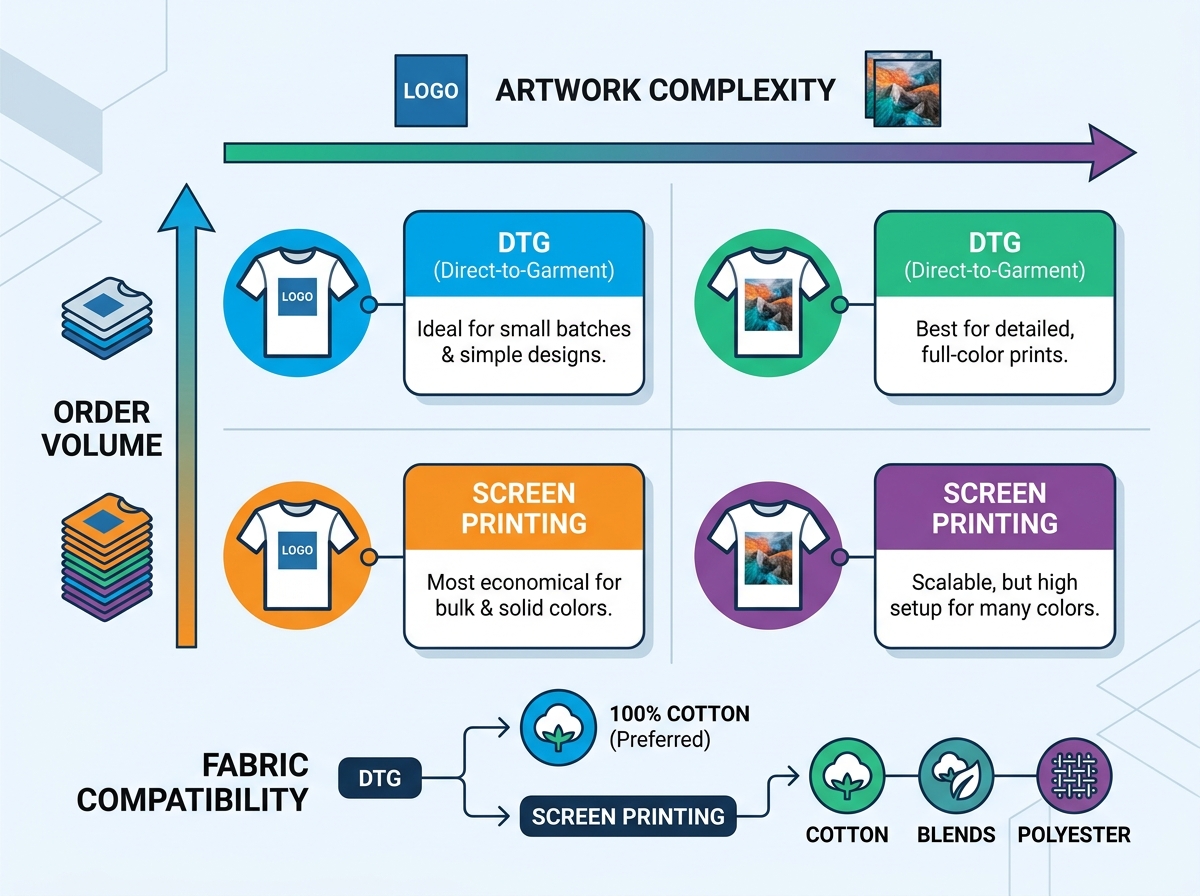
Buyers constantly debate screen printing vs DTG. Both excel in specific scenarios. You must evaluate four core variables to make the right choice.
Volume dictates your baseline economics. Under 50 units, digital application is highly cost-effective. You avoid expensive physical setup fees entirely. For orders of 50 units or more, traditional stenciling becomes the dominant economical choice. Economies of scale quickly offset the initial labor and material costs.
Look closely at your design files. Do you have vector art using one to four solid colors? Choose traditional stenciling immediately. Are you printing photographs, subtle gradients, or designs boasting over five colors? Digital application will yield much better results without ballooning your budget.
Plastisol formulations outlast most garments. They endure rigorous washing cycles for years. Digital applications are also highly durable today. However, they may fade slightly faster under aggressive washing routines. You must instruct customers to wash them inside out on cold settings.
Traditional stencils work on almost anything. You can push plastisol through mesh onto cotton, polyester, or nylon. Digital application strictly prefers 80-100% natural fibers. Synthetic fibers actively repel the water-based formulations used in digital machinery.
Technical Decision Overview Chart
| Evaluation Criteria | Screen Printing | Direct-to-Garment (DTG) |
|---|---|---|
| Ideal Order Volume | 50+ units | 1 to 49 units |
| Artwork Type | Solid colors, vector graphics | Photographs, gradients, complex colors |
| Fabric Preference | Works on nearly all textiles | Requires 80-100% Cotton |
| Durability | Extremely high (lasts years) | High (may fade slightly over time) |
Pairing materials and techniques correctly prevents disaster. Some combinations yield incredible retail-ready merchandise. Others result in cracked, faded, or rejected goods. We rely on a strict compatibility matrix to guide all production decisions.
Your production partner dictates your ultimate success. Finding a reliable custom t shirt manufacturer mitigates immense risk. You should evaluate them rigorously across several critical dimensions before signing any contracts.
A great partner offers multiple techniques under one roof. They should provide objective recommendations based solely on your art. Beware of shops forcing a single technology. They might recommend digital application for a 500-unit solid-color run just because they lack traditional equipment.
Evaluate their Minimum Order Quantities carefully. Do they align perfectly with your current pilot needs? More importantly, can they handle your future replenishment requirements? You need a partner who grows alongside your brand seamlessly.
Modern consumers demand ethical production. Verify absolute transparency in textile sourcing. Look for OEKO-TEX certifications guaranteeing safe, non-toxic materials. Ensure they enforce strict ethical labor practices. Your brand reputation depends entirely on their operational compliance.
The ideal apparel strategy relies entirely on intersectionality. You must balance your artwork complexity, the garment's end-use, and your total order volume. No single technique works for every scenario. No single textile satisfies every consumer. You must apply the rigorous matrix rules we covered above to ensure high-quality outcomes.
Your next steps are clear. First, finalize your artwork file as a clean vector or high-resolution raster. Next, calculate your initial volume requirements accurately. Finally, initiate a quoting process with a vetted factory using these strict evaluation criteria. By removing the guesswork, you can consistently produce merchandise your customers actually want to wear.
A: Screen printing with plastisol ink is generally the most durable option available. The heavy ink bonds securely to the fibers. It often outlasts the fabric itself if cured properly in a commercial dryer.
A: No. DTG water-based inks do not bind well to synthetic plastics. Attempting this results in a faded, washed-out look. It also causes severe dye migration and exceptionally poor washfastness.
A: Fabric weight is measured in GSM (grams per square meter) or ounces. 4.3 oz to 5.0 oz is a standard mid-weight. This range remains highly suitable for most promotional and retail applications.
A: Each color requires a separate physical screen. Operators must coat, burn, align, and clean every single stencil. This intensive process drives up initial labor and material setup costs significantly.


