
Views: 0 Author: Site Editor Publish Time: 2026-10-13 Origin: Site


Beautiful fashion sketches rarely translate into market-ready garments without friction. You might draft a stunning silhouette on paper. However, moving it to the retail rack presents a rigorous supply chain challenge. It requires far more than a creative vision. Launching a dress line exposes founders to harsh operational realities. You must identify reliable manufacturing partners early on. You must control sample quality at every step. You also have to manage unit economics strictly to stay profitable.
This guide offers a realistic, end-to-end framework for apparel founders. We will explore sourcing strategies and evaluate production partners. You will learn how to manage the complete lifecycle for your fashion brand. From initial tech packs to final random inspections, this roadmap bridges the gap between raw ideas and scalable inventory.
Brand founders often struggle during the initial planning phase. They face a tough cost-benefit analysis. Should you start entirely from scratch? Should you utilize pre-existing patterns? Answering these questions dictates your entire supply chain model. The two primary paths are white labeling and bespoke development.
Purchasing unbranded, pre-designed styles defines the white-label approach. You buy finished garments and attach your brand tags. Private label dresses offer a highly accessible entry point into the fashion market.
This strategy provides significantly lower MOQs (Minimum Order Quantities). It also ensures a much faster time-to-market. You skip the lengthy pattern-making and sampling phases entirely. However, this route lacks product differentiation. It generally offers lower profit margins. You cannot claim ownership over the garment silhouette.
We recommend this approach for brands testing the market. It works perfectly for influencer merchandise. Businesses prioritizing a rapid launch over unique silhouettes should strongly consider this method.
Creating a garment entirely from scratch defines full development. You build bespoke patterns, establish grading rules, and source raw materials. When you decide to develop a unique custom dress, you control every stitch.
This approach delivers maximum differentiation. You retain full ownership of your Intellectual Property (IP). Nobody else can legally sell your exact design. Conversely, it demands a higher upfront financial investment. It requires longer lead times. It also demands strict manufacturing oversight.
This path suits high-end labels perfectly. Brands with niche fit requirements must use this method. It remains the best option for long-term brand building and establishing industry authority.
| Feature | Private Label Dresses | Full Custom Development |
|---|---|---|
| Time to Market | Fast (4-8 weeks) | Slow (3-6 months) |
| Upfront Costs | Low | High |
| Design Ownership (IP) | None | 100% Owned |
| Differentiation | Low | High |
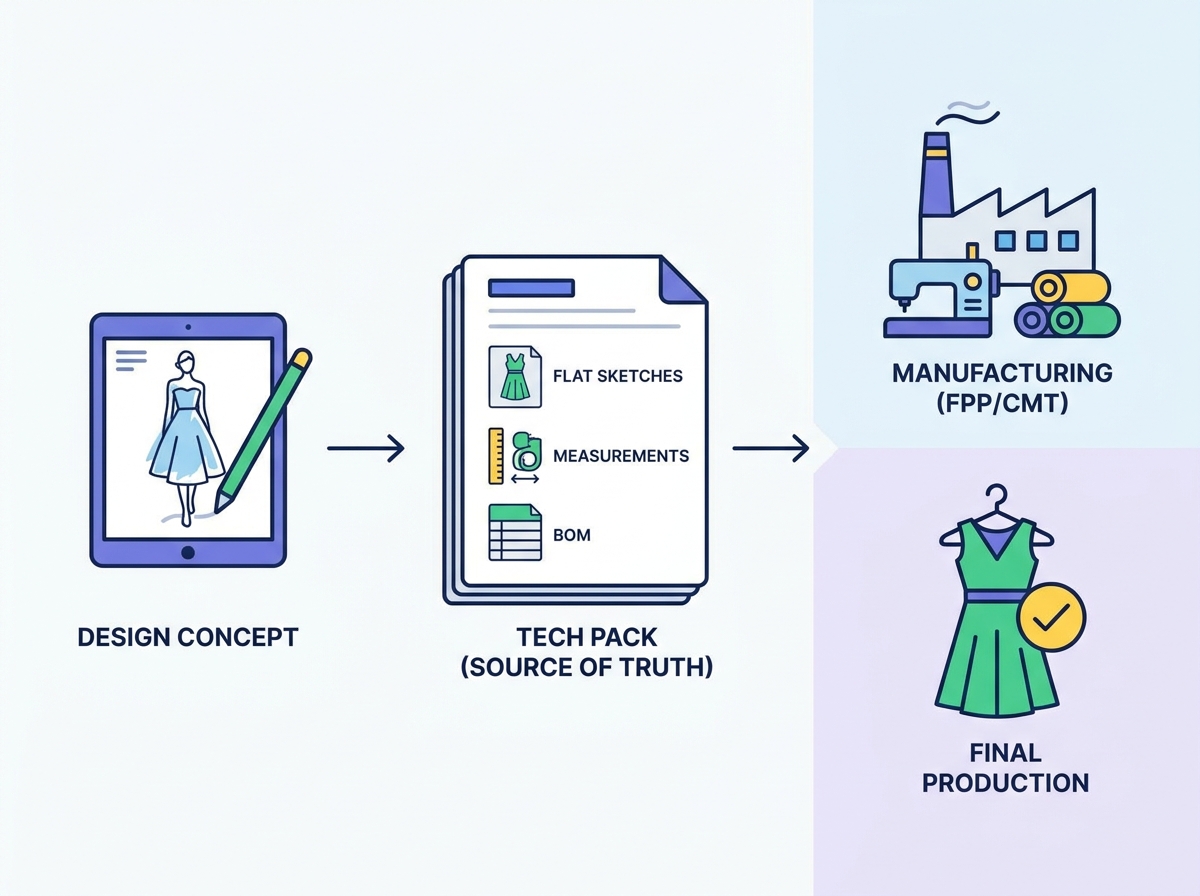
Many founders misunderstand the reality of apparel design. A beautiful mood board is completely insufficient for factory operators. Professional custom dress design translates fluid sketches into rigid technical data. Factories build garments based on numbers, not emotions.
A Technical Package serves as the ultimate blueprint. It acts as the binding contract between you and your factory. If a detail is missing from the tech pack, you cannot penalize the factory for omitting it. A robust tech pack must include several mandatory components:
Material choices directly dictate factory selection. Material impacts drape, cost, and machine requirements. A factory specializing in woven silk evening wear rarely possesses the machinery for high-stretch athletic knits. You must align your material profile with your partner's core competencies. Sourcing the wrong fabric causes immediate tension on the sewing floor.
Digital fashion software transforms early development stages. Programs simulate drape, fabric tension, and fit before cutting any physical material. 3D prototyping drastically reduces sampling iterations. You catch proportion errors on a screen rather than paying for a ruined physical sample. This modern workflow saves weeks of transit time and thousands of dollars.
Finding a factory feels overwhelming. The key is knowing exactly what service level you need before sending an inquiry. Your operational capability determines the correct manufacturing category.
The industry categorizes factories by their service scope. You must choose between FPP and CMT models.
Full Production Package (FPP) means the factory handles everything. They manage pattern-making, material sourcing, cutting, and final assembly. You pay a higher cost per unit. However, you face a significantly lower operational burden. You hand them a tech pack. They hand you finished garments.
Cut, Make, Trim (CMT) requires you to supply all raw materials. The brand purchases fabrics, threads, and zippers. You ship these goods to the factory. The factory only provides the manual labor. This model yields a higher profit margin. Yet, it places an extreme operational burden on you. A missing box of buttons will halt the entire assembly line.
When you interview a potential custom dress manufacturer, apply a strict vetting process. Never select a partner based solely on an attractive website.
Implementation realities surprise many new designers. The very first sample will almost certainly look wrong. This is completely normal. Frame the sampling phase as a necessary stress-test. You are testing the manufacturer's capabilities as much as the garment's fit.
You cannot jump straight from a sketch to bulk manufacturing. Proper custom dress production follows a rigid prototyping sequence.
| Sample Type | Purpose | Material Used |
|---|---|---|
| Muslin / Toile | Test basic fit, proportion, and silhouette lines. | Substitute, cheap fabric (like raw cotton). |
| Fit Sample | Refine the drape and evaluate construction methods. | Actual chosen fabric (or very close substitute). |
| PP Sample (Pre-Production) | Serve as the final standard for the bulk sewing line. | Exact fabric, correct trims, final finishes. |
| Size Run Sample | Verify grading rules across the entire sizing spectrum. | Final fabric (often one garment per size). |
Sampling prevents expensive bulk errors. You must track tolerance limits closely. Tolerances dictate acceptable measurement deviations. For example, a half-inch variance on a loose maxi dress is acceptable. A half-inch variance on a structured bodice ruins the fit.
Always document feedback meticulously. Do not send casual emails saying "make the sleeves tighter." Update the tech pack. Add visual annotations to photos of the sample. Resend the revised tech pack. Keep a clear paper trail.
Entering the production phase requires strict discipline. This happens immediately after you sign off on the PP sample. You must establish a binding timeline. Agree on a fixed delivery schedule before transferring the bulk deposit.
You cannot rely on the factory to police itself entirely. Standardize your quality checks using the AQL (Acceptable Quality Limit) method. AQL provides a statistical measurement system. It tells you how many defective units are acceptable in a batch before you reject the entire shipment. An AQL of 2.5 is a common apparel standard.
Implement In-line Inspections. Hire a third-party QC firm to check garments while they sit on the active sewing line. Catching a systemic error here saves the batch. If workers are attaching zippers backward, you fix it immediately.
Always mandate a Final Random Inspection (FRI). Inspectors evaluate finished, packed garments before the factory ships them out. They check stitching, measurements, and packaging integrity. Never pay the final invoice until the FRI report comes back clean.
Failing to plan logistics destroys profit margins. Brief considerations on landed costs are essential. Landed cost equals the garment price plus freight forwarding, customs duties, and warehouse receiving fees. Ocean freight is cheap but takes 30 to 45 days. Air freight takes a week but severely inflates your unit cost. Plan your launch dates around realistic ocean freight schedules.
Successful garment development relies on systematic execution rather than pure creative flair. You must translate technical design accurately. You must execute rigorous factory vetting. By utilizing detailed tech packs and strict sampling protocols, you protect your capital.
Take immediate action on your concepts today. Finalize your tech packs to ensure every measurement is locked in. Begin reaching out to shortlisted manufacturers for preliminary capability checks and MOQ inquiries. Your fashion brand becomes a reality the moment you organize your supply chain.
A: Minimum Order Quantities vary widely. Domestic micro-factories might accept MOQs as low as 50 units per style. Large overseas facilities typically require 300 to 500 units per colorway. Always negotiate MOQs during your initial inquiry to align with your budget.
A: Costs depend entirely on complexity and volume. Development involves sample fees, which often run $150 to $500 per prototype. Bulk unit costs include materials, labor, and freight. As your production volume increases, your cost per unit drops significantly.
A: Use Non-Disclosure Agreements (NDAs) domestically. For international manufacturing, especially in Asia, utilize NNN agreements (Non-Disclosure, Non-Use, Non-Circumvention). Trademark your brand name and logos. However, know that copyrighting a basic garment silhouette remains legally difficult.
A: Building a product from scratch requires patience. Expect 4 to 8 weeks strictly for prototyping and sample revisions. Once you approve the final sample, bulk manufacturing takes 30 to 90 days. Shipping adds another 1 to 6 weeks.


