
Views: 0 Author: Site Editor Publish Time: 2026-10-13 Origin: Site


Launching a successful line of custom pants hinges on two uncompromising variables: fabric performance and fit consistency. Nailing these elements determines whether a collection thrives or struggles in a highly competitive market. For apparel brands and uniform buyers, the cost of getting these wrong is remarkably severe. Poor choices manifest quickly as high return rates, negative customer reviews, and expensive dead stock. Evaluating materials and silhouettes goes far beyond basic aesthetics. It requires aligning your initial design intent with harsh supply chain realities. Brands must engineer their garments for longevity, daily wear, and rigorous washing cycles.
This guide outlines the exact technical criteria for selecting the best textiles for your upcoming production run. We will explore how to standardize fit through precise grading and rigorous documentation. Finally, you will learn how to vet a reliable partner capable of executing your vision at scale, ensuring every garment meets your exact specifications.
Thorough material and pattern evaluation matters deeply at the primary decision stage. Launching private label pants requires intensive planning before mass production begins. Fit issues cause immense friction for consumers. They remain the leading driver of apparel returns across the fashion industry. Precision engineering protects your profit margins by drastically reducing these expensive return logistics.
We must also consider brand equity and long-term durability. The way hardware interacts with your chosen textiles determines the garment lifespan. Heavy-duty brass zippers need sturdy, reinforced waistbands. Delicate clasps will tear through thin materials after just a few wears. Seamless integration between hardware and textile builds trust with your customer base. They recognize quality when garments survive years of regular use.
Finally, evaluate the cost-to-value ratio. You must balance high-end material sourcing against your target retail pricing. Commercial viability relies entirely on this delicate balance. Using premium Italian wool increases your baseline costs significantly. You must ensure your target demographic will absorb that premium price point. Lower-cost synthetic blends offer wider margins but may sacrifice breathability. Every material decision directly shapes your financial outcomes.
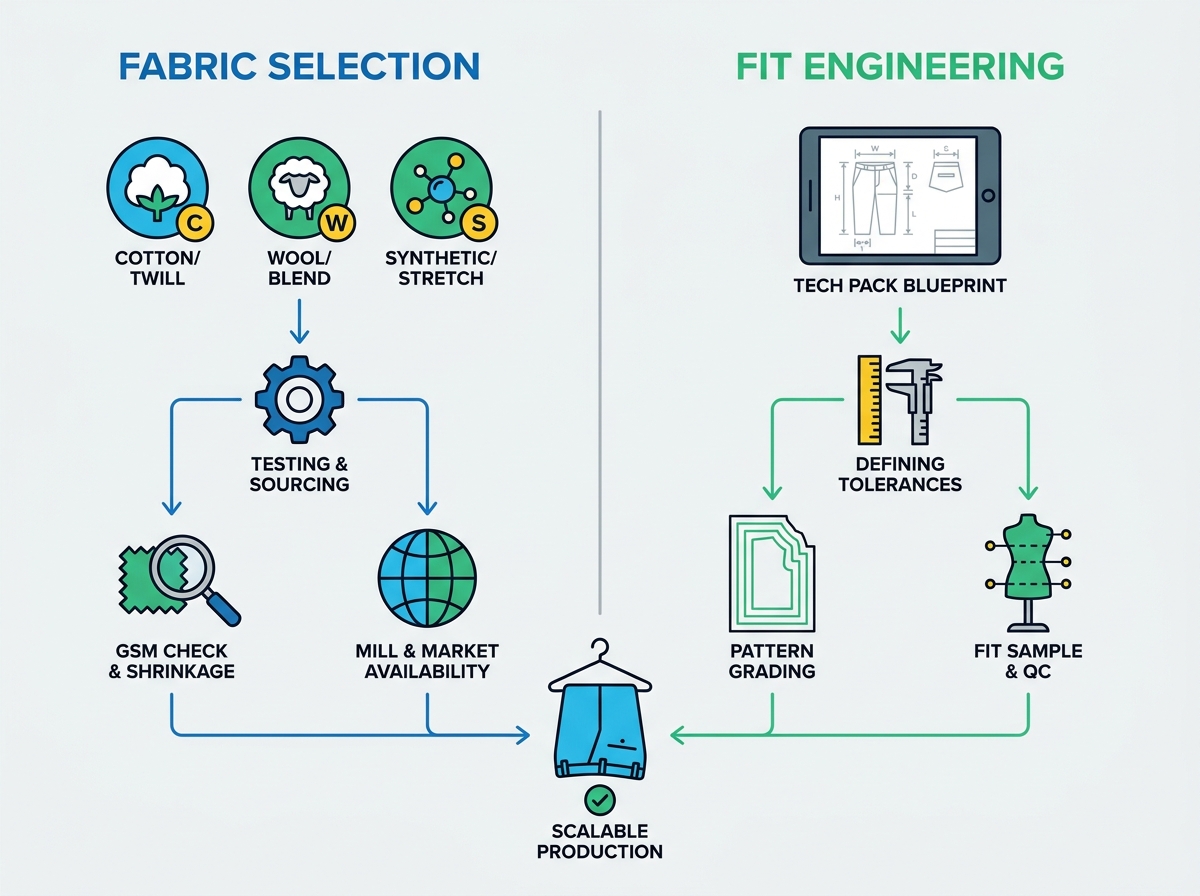
Understanding weight and drape is crucial for garment success. Grams per Square Meter (GSM) dictates the seasonality and durability of your product. It controls the structural hold of your garment on the body. Choosing the right custom pants fabric changes how the silhouette falls. Lightweight materials (150-200 GSM) suit summer collections perfectly. Heavyweight textiles (350+ GSM) provide the necessary warmth and structure for winter lines.
Different applications require vastly different material compositions. We break these down into three primary categories:
Textile sourcing introduces distinct logistical realities. Milled-to-order textiles require significantly higher minimums. They offer exact color matching to your specific Pantone codes. This route provides ultimate brand control but demands longer lead times. Deadstock or open-market fabrics offer much lower minimums. However, they present significant availability risks. Once a deadstock roll runs out, you cannot reorder it for future collections.
| Category | Primary Use Case | Ideal GSM Range | Key Performance Metric |
|---|---|---|---|
| Cottons & Twills | Chinos, Workwear, Casual | 200 - 300 GSM | Shrinkage Resistance |
| Wools & Blends | Formal Trousers, Suiting | 250 - 350 GSM | Drape & Wrinkle Recovery |
| Synthetics & Stretch | Athleisure, Golf, Performance | 150 - 250 GSM | Shape Retention (Elastane %) |
Moving beyond basic S/M/L sizing models is absolutely mandatory. Standard models fail miserably for tailored fits. Human bodies carry weight differently across the waist, hips, and thighs. You need granular sizing approaches to accommodate different builds.
The Tech Pack acts as your ultimate production blueprint. Relying simply on reference garments invites disaster. Your tech pack must include detailed technical sketches. You must add exact Point of Measure (POM) guidelines. Specify all hardware placements clearly. A comprehensive document removes guesswork from the factory floor.
Your tech pack should clearly define the following measurements:
Defining manufacturing tolerances keeps factories accountable during bulk runs. You must set acceptable variance limits early. For example, allow only +/- 0.5 inches on the inseam. A medium waist designated at 32 inches can measure between 31.5 and 32.5 inches. Anything outside this window fails inspection. This protects your bulk quality control standards.
Pattern grading ensures scalability across your entire customer base. The integrity of the original fit must hold up. It should look proportional across the entire size run. Proper grading prevents strange proportions in larger sizes. It adjusts the rise and thigh width non-linearly to match realistic human anatomy.
Choosing a reliable custom pants manufacturer shapes your entire business trajectory. First, determine the right engagement model. You must choose between cut-and-sew or white label production. Cut-and-sew delivers proprietary silhouettes built entirely from scratch. It offers total control over fit and finish. White label offers rapid speed-to-market by utilizing pre-existing factory patterns. You simply attach your branding to proven templates.
You must rigorously vet their specific factory capabilities. Ask detailed questions during your initial meetings:
Standard single-needle sewing machines cannot handle high-end trouser production effectively. Specialized equipment separates premium factories from generic apparel makers.
Assess Minimum Order Quantities (MOQs) and general scalability next. Ensure their minimums align comfortably with your available capital. Boutique factories might accept 50 units per style. Large industrial facilities often demand 500 units or more. Confirm they can seamlessly scale production as your brand volume grows over time.
Finally, verify compliance and ethical standards. Look for established industry certifications. Certifications like WRAP (Worldwide Responsible Accredited Production) ensure ethical labor practices. ISO certifications guarantee rigorous quality management systems. OEKO-TEX indicates textiles remain free from harmful, toxic chemicals. These credentials protect your brand reputation from supply chain scandals.
You must actively de-risk your production run through staged prototyping. The sampling timeline requires patience and strict attention to detail. It progresses logically from a basic Fit Sample to a finalized Pre-Production (PP) Sample. The fit sample exists purely to test the paper pattern on a human body. The PP sample serves as the exact replica for your incoming bulk order. Never authorize bulk custom pants manufacturing without holding an approved PP sample in your hands.
Independent wash and wear testing is absolutely critical. You should personally wash the fit sample several times. Test it for dimensional stability using standard home laundry settings. Monitor the seams carefully for unwanted puckering. Check the colorfastness to ensure dyes do not bleed onto other garments. A perfect showroom sample means nothing if it shrinks three sizes after one wash cycle.
Finalize your manufacturing contract securely. Tie the approval of the PP sample directly to your written agreements. Set clear terms regarding acceptable defect rates. Attach bulk payment milestones to these strict quality standards. A standard practice involves paying 30% upfront for materials. You hold the remaining 70% until a third-party inspection passes the final bulk run. This structure keeps the factory incentivized to maintain high standards throughout production.
Sourcing exceptional textiles and finalizing fits is an exact science. It demands comprehensive documentation, clear communication, and highly capable manufacturing partners. By respecting the technical nuances of garment construction, you protect your brand from costly logistical failures.
Take these actionable steps to move forward:
A: MOQs vary widely across the industry. Boutique cut-and-sew operations might accept as few as 50 units per style. Large-scale industrial factories typically require 500 or more units. These minimums depend heavily on factory scale and specific fabric sourcing requirements.
A: Emphasize sourcing pre-shrunk fabrics early in the design process. Require rigorous wash tests during the sampling phase. Finally, factor specific shrinkage tolerances directly into your pattern grading to account for natural fiber contraction.
A: Private label involves rebranding pre-existing factory designs, offering faster turnaround and lower MOQs. Cut-and-sew involves creating a garment entirely from scratch using unique patterns and raw materials. It offers higher customization but requires longer lead times.
A: The sampling process typically takes 3 to 6 weeks. This timeframe depends on raw material availability and the number of pattern revisions required. Rushing this crucial phase inevitably leads to expensive bulk production errors.


